Category Archives: JMPs

Spatial economics JMPs (2025-2026)

Here’s a list of job-market candidates whose job-market papers fall within spatial economics, as defined by me quickly skimming webpages and two dozen candidates who responded on Twitter. I’m sure I missed folks, so please add them in the comments.

Here’s a cloud of the words that appear in these papers’ titles:

Yuanhang Yu (LSE) – Pollution Without Borders: Transboundary Air Pollution and the Geography of Pollutant Control Policy
Po-Shyan Wu (Indiana) – Assault on the Low-Wage Economy: Federal Wage-Hour Law and Southern Industrial Development
Jacob Wright (Minnesota) – On the Spatial Distribution of Colleges
Martin Wiegand (UPF) – Cities with Benefits
Zhichun Wang (Yale) – The Expansion and Dynamic Equilibrium Effects of Institutional Landlords
Óscar Vilargunter (Toulouse) – Spatial Effects of the Minimum Wage
Michael Tueting (St. Gallen) – Climate Change, Income Inequality, and Migration in a Spatial Economy
Tuyetanh Tran (Yale) – The Trade-Offs of Curbside Parking: Evidence from Demand-Based Pricing
Anya Tarascina (Wisconsin) – The Value of Intermediation in Bikeshare
Idil Tanrisever (UCI) – Upzoning and Neighborhood Change: Evidence from Los Angeles
Caterina Soto Vieira (LSE) – Home Production in the City
Christopher Sims (Northwestern) – The Origins of the Nitrogen Revolution
Jacob Shepard (Arizona State) – Spatial Mobility and the Macroeconomic Effects of Housing Policy
Jin Seok Park (USC) – Priced Out of Entrepreneurship? Rising Local Home Prices Lower Economic Opportunities for Young Renters
Bas Sanders (Harvard) – A New Bayesian Bootstrap for Quantitative Trade and Spatial Models
Álvaro Sánchez-Leache (CEMFI) – The Internal Geography of America’s Housing Crisis
Matteo Saccarola (Berkeley) – Geographic Price Extrapolation, Learning, and Housing Search: Evidence from Danish Movers
Brietta Russell (Oregon) – Short-Term Rental Regulations, Enforcement, and Host Behavior: Evidence from Denver
Francesco Ruggieri (Chicago) – Overlapping Jurisdictions and the Provision of Local Public Goods in U.S. Metropolitan Areas
Vincent Rollet (MIT) – Zoning and the Dynamics of Urban Redevelopment
Christina Qiu (Yale) – Endogenous Transfer Networks Under Spatial Risk
Zeyi Qian (Clark University) – Trade Costs, Entry Costs, and Regional Economic Growth in China
Helena Pedrotti (NYU) – Local Discretion in Low-Income Housing Policy: Evidence from France
Giovanni Paolo Mariani (ULB ECARES) – The Value of Local Public Goods: Evidence from Massachusetts’ Property Tax Limits
Junni Pan (Purdue) – Migration Restrictions, College Choices, and Spatial Skill Sorting
Julian Oolman (Illinois) – Endogenous Consumption Amenities of the Country Mouse and City Mouse
Fernando Ochoa (NYU) – Targeting and Price Pass-Through in Housing Voucher Design
Matias Navarro (Cornell) – On the Right Track? Designing Optimal Public Transit Contracts
Alberto Nasi (Bocconi) – Mortgage Rates and the Price-to-Rent Ratio Across Space
Jordan Mosqueda (UCSD) – Equilibrium Commuting Costs: The Role of Private and Public Transit
Iris Margetis (Michigan State) – The Effects of a Mandatory Flood Risk Disclosure Law on Rent Prices and Residential Sorting in Texas
Anna Lukianova (Wisconsin) – Income Taxation, Entrepreneurship, and Inequality in the U.S.
Feng Lin (Chicago) – Sorting, Displacement, and the Limited Welfare Benefits of Non-Local Firms
Furkan Kilic (Chicago) – Spatial Allocation of Inventors, Knowledge Diffusion and Growth
Aja Kennedy (Tufts) – Local Spillover Effects of Density Bonus Policy on Housing Production: Evidence in Massachusetts
Zane Kashner (Stanford GSB) – Building with Externalities: Local Governments and Wind Farms
Nathan Jones (UPF) – Pricing Out the Poor: Income Segregation and Housing Supply Regulation
Richard Jin (Berkeley) – College Alumni Networks and Mobility Across Local Labor Markets
Jiahao Jiang (Virginia) – Rise of Homeownership in China: Insights from a Life Cycle Analysis
Yuyang Jiang (Princeton) – Strategic Transportation Investment and Coordinative Policies: Evidence from the U.S. Highway Network
Yikuan Ji (UMD) – Travel Mode Choice and Distributional Impacts of Congestion Charge Policy in New York City
Razi Iqbal (Michigan) – Sectoral and spatial reallocation via multi-establishment firms
Ji Hwan Kim (UPenn) – Adapting to Storms in the U.S.: A Spatial Dynamic Analysis
Zong Huang (Stanford) – The Redistributive and Efficiency Effects of Property Taxes
Bisma Haseeb Khan (Toronto) – Public Transit, Residential Sorting and Labor Supply: Evidence and Theory from Lahore’s Bus Rapid Transit System
Raymond Han (MIT) – Equilibrium Effects of Neighborhood Schools
Lucy Hackett (Berkeley ARE) – Land subsidence: Environmental risk in housing markets in Mexico City
David H. Buller (Illinois) – Estimating Spatial Heterogeneity in the Labor Market Effects of Place-Based Business Incentive Deals
Gabrielle Grafton (Brown) – The Great Migration and Those Left Behind
Daniel Gold (Wisconsin) – Regulatory Hurdles and Costly Delay in Housing Development
Sebastian Espinoza Rojas (UCL) – Market Power and Local Labor Markets
Plinio Dias Bicalho Jr (Boston U) – Quantifying the Macroeconomic Effects of Tax Competition: the Brazilian “Fiscal War”
Agustín Deambrosi (Penn State) – When, where, and how quickly? A model of Venezuelan stepwise migration with network effects, credit constraints, and official assistance
Lindsey Currier (Harvard) – Competition in U.S. Infrastructure
Benjamin Couillard (Toronto) – Build, Baby, Build: How Housing Shapes Fertility
Beau Bressler (UC Davis) – Building Segregation: The Long-Run Neighborhood Effects of American Public Housing
Lukas Boehnert (Oxford) – The Regional Specialization Trade-off
Devin Bissky Dziadyk (Toronto) – Little School on the Prairie: A Push for Structural Transformation
Aditya Bhandari (Chicago) – Technology and the Geography of Industrial Policy
Sebastián Bauer (Stanford GSB) – Competition and Welfare in Airport Slot Allocation
Elif Basaran (Penn State) – Refugees, Amenities, and the Skill Premium
Mark Bamba (Princeton) – The Centralizing Effects of Tokyo’s Train System
Abdelrahman Amer (Toronto) – Monopsony in Space: Commuting & Labor Market Power
Elena Aguilar (Princeton) – Credit Constraints, Learning, and Spatial Misallocation

Trade JMPs (2025-2026)

For the 16th year running, I’ve gathered a list of trade-related job-market papers. If I’ve missed someone, please contribute to the list in the comments.

Here’s a cloud of the words that appear in these papers’ titles:

Fanwen Zhu (UCLA) – Sanctions and Startups: Trade Shocks and Innovator Entrepreneurship in the U.S.-China Trade War
Qi Zhang (Virginia) – Pollution Haven Next Door: Evidence from China
Viktoriia Zezerova (Penn State) – Market Power, Misallocation, and Trade Policy
Chek Yin Choi (IIES) – Supplier Search and Market Concentration
Yan Yan (Yale University) – The Informational Value of Lobbying in the Tariff Exclusion Process – https://yanyan-econ.github.io
Yuyao Wu (Michigan) – State Ownership and International Business Cycle
Cihang Wang (UIUC) – Taxing Production Networks: Trade, Misallocation, and Vertical Integration
Tao Wang (CEMFI) – Beyond Cheap Supplies: Risk and Competition in Global Sourcing
Germano Wallerstein (Michigan) – Exporter entry, expansion, and the skill premium
Barron Tsai (Duke University) – When Cutting Out the Middleman Backfires: Disintermediation, Wholesale Markups, and Misallocation
Ngan Tran (Oregon) – Unequal Gains: The Gendered Impact of Trade Liberalization in Vietnam
Lidia Smitkova (Oxford) – Export Subsidies as Industrial Policy: the Case of the 19th Century Sugar Industry
Sebastian Sardon (Northwestern) – Trade, Land Consolidation, and Agricultural Productivity
Bas Sanders (Harvard) – A New Bayesian Bootstrap for Quantitative Trade and Spatial Models
Alisha Saini (University of Illinois Chicago) – How Government Procurement affects Trade: Evidence from the U.S.
Jose Rojas-Fallas (Oregon) – Global Firms, Local Students: Multinational Presence Shapes College Major Choice
Yinan Qiu (Princeton) – Venture Capital Networks and Cross-Border Startup Knowledge Spillovers
Alberto Palazzolo (ULB ECARES) – Deglobalization and the Reorganization of Supply chains: Effects on Regional Inequalities in the EU
Guilherme Paiva Pinto (Indiana) – External Negotiations and Customs Union Stability
Saera Oh (Michigan State) – Related Party Trade and Gravity: Revisiting the Distance Effects
Vishan Nigam (MIT) – Specialization by design: the unequal geographic effects of modular product design
Ashwin Nair (Virginia) – Paving the Way for Higher Costs? The Impact of Steel Tariffs on Highway Procurement
Timothy Meyer (Uni Bonn, Kiel Institute) – Hegemonic Competition with Carrots and Sticks
Hubert Massoni (Bologna) – Climate Trade Costs: Extreme Weather, Transportation, and Supply Chains
Ignacio Marra de Artiñano (ULB ECARES) – The Labor Market Effects of Multinational Entry
Max Marczinek (Oxford) – Labour Scarcity and Productivity: Insights from the Last Nordic Plague
Jacob Lefler (Berkeley ARE) – Freight in the Time of Covid: A Model of US Trucking
Taylor Lathrop (Syracuse) – Foreign Direct Investment and Local Productivity Spillovers: Evidence from Indonesia
Guido Lamarmora (Nottingham) – The Food Problem in an Open Economy
Ananya Kotia (London School of Economics) – When Competition Compels Change: Trade, Management, and Productivity
Xianglong Kong (Chicago) – Learning in Firm-to-Firm Trade
Kazuma Inagaki (Rochester) – Born Global, New Exporter Dynamics and the Aggregate Gains from Trade
Vanya Georgieva (Toronto) – Trade and Industrial Policy with Global Production Networks
Enrico Cristoforoni (Boston College) – International Prices, Domestic Wages, and Labor Market Power
Junyuan Chen (UCSD) – Sourcing Frictions Meet Inventories: A Dynamic Ricardian Framework for the Impact of Trade Shocks
Yaming Chang (Penn State) – Trade, Research Productivity and Growth: A Dynamic General Equilibrium Approach
Jonas Casper (LMU Munich) – Unproductive Exporters
Carlos Bolivar (Minnesota) – The Micro Effects of Aggregate Shocks in Endogenous Trade Networks
Shania Bhalotia (LSE) – Trade in Services under Regulatory Barriers: Evidence from UK Banking

Spatial economics JMPs (2024-2025)

Here’s a list of job-market candidates whose job-market papers fall within spatial economics, as defined by me quickly skimming webpages and 24 candidates who responded on Twitter. I’m sure I missed folks, so please add them in the comments.

Here’s a cloud of the words that appear in these papers’ titles:

Deepti Sikri (Albany) – The Fiscal Effects of Housing Prices: Evidence from School Districts
Ozgen Kiribrahim-Sarikaya (Arizona State) – Place-Based Environmental Regulations and Labor Market Dynamics
Marianna Magagnoli (Barcelona) – The price of silence
Konhee Chang (Berkeley Haas) – Diversifying the suburbs: Rental supply and spatial inequality
Lei Ma (Boston University) – Build What and for Whom? The Distributional Effects of Housing Supply
Peter Deffebach (Boston University) – Labor Market Churn, Development, and Quits: Evidence from Urban Ghana
Michael Neubauer (Brown) – Race, Poverty, and the Changing American Suburbs
Jake Fabian (Brown) – The Price of Risk: Flood Insurance Premium Reform and Housing Development
Megan Haasbroek (Cambridge postdoc) – Land Acquisition Costs and Sectoral Composition: Evidence from India
Fern Ramoutar (Chicago Booth) – Market Power in Residential Real Estate: Evidence from Chicago Rental Properties
Jeanne Sorin (Chicago) – Public Roads on Private Lands: Land Costs and Optimal Road Improvements in Urban Uganda
Thomas Hierons (Chicago) – Spreading the Jam: Optimal Congestion Pricing in General Equilibrium
Jordan Rosenthal-Kay (Chicago) – Urban costs around the world
Dongkyu Yang (Colorado) – Time to Accumulate: The Great Migration and the Rise of the American South
Matthew Easton (Columbia) – Populations in Spatial Equilibrium
Emiliano Harris (Cornell) – The First Era of American Federal Public Housing (1940-1960) Effects on Neighborhoods
Thomas Monnier (CREST) – The Informality Trade-Off: Wages and Rural-Urban Migration in South Africa
Yan Hu (Edinburgh postdoc) – The roadblock effect: War shocks, modal shifts, and population changes
Yanbin Xu (Georgetown) – Internal Migration Restrictions, Aggregate Productivity, and Spatial Growth
Leonardo D’Amico (Harvard) – Capital Market Integration and Growth Across the United States
Oluchi Mbonu (Harvard) – Market Segmentation and Coordination Costs: Evidence from Johannesburg’s Minibus Networks
Martin Koenen (Harvard) – Social Ties and Residential Choice: Micro Evidence and Equilibrium Implications
Sébastien Box-Couillard (Illinois) – Do Minorities Pay More to Avoid Flood Risk?
Sidharth Moktan (LSE) – An Empirical Equilibrium Model of the Markets for Rental and Owner-Occupied Housing
Giorgio Ravalli (LSE) – The Effect of Transport Infrastructure on Innovation: The Role of Market Access in the English Railway Boom
Sandra Kurniawati (Mannheim) – Quantifying the Effects of Commodity Booms on Regional and Sectoral Outcomes
Daniel O’Connor (MIT) – Revitalize or Relocate: Optimal Place-based Transfers for Local Recessions
Tishara Garg (MIT) – Can Industrial Policy overcome Coordination Failures? Theory and Evidence
Daniel Velasquez (Michigan) – Highways, Commuting and Trade: Unpacking Suburban Growth
Chun Chee Kok (Monash) – Ethnic Proximity and Politics: Evidence from Colonial Resettlement in Malaysia
Helena Pedrotti (NYU) – Local Discretion in Low Income Housing Policy
Hyeseon Shin (Ohio State) – Agriculture, trade, migration, and climate change
Amrutha Manjunath (Penn State) – Language Barriers, Internal Migration, and Labor Markets in General Equilibrium
Dongyang He (Penn State) – The Distributional Effects of Residential Zoning Policies: Insights from the Greater Boston Area
Felipe Barbieri (Penn) – Market Power and the Welfare Effects of Institutional Landlords
Mikhail Zavarzin (Pittsburgh) – Work from Home and Spatial Misallocation
Allison Green (Princeton) – Networks and Geographic Mobility: Evidence from World War II Navy Ships
Huilin Zhang (Purdue) – Productivity Externality of Working from Home: Welfare and Policy Implications
Sisi Zhou (Purdue) – Residential Sorting and Access to Consumption
Sihui Ong (Queens) – Are Uniform or Fragmented Carbon Taxes Optimal? Evidence from Canadian Manufacturing
Daniel Teeter (Queens) – The Impact of Internal Trade Liberalizations on Plant Productivity and Markups
Brad Ross (Stanford GSB) – Measuring and Mitigating Traffic Externalities
James Macek (Toronto) – Housing Regulation and Neighborhood Sorting Across the US
Maximilian Günnewig-Mönert (Trinity College Dublin) – Public housing design, racial sorting and welfare: Evidence from New York City public housing 1930-2010
Carolyn Pelnik (Tufts) – Moving to Profitability? Alleviating Constraints on Microentrepreneur Location
Manali Sovani (Tufts) – Women on the Move: Effect of Transportation Access on Women’s Education in Delhi
Alice Wang (UBC Sauder) – Are Highways Conduits or Barriers for Urban Travelers? A Welfare Analysis Using Smartphone Data
Pablo Valenzuela-Casasempere (UBC) – Displacement and Infrastructure Provision: Evidence from the Interstate Highway System
Max Norton (UBC) – Who benefits from local bond elections? Evidence from California’s school bond reform
Alexander Abajian (UC Santa Barbara) – Savings and Migration in a Warming World
Marko Irisarri (UPF) – Entrepreneurship Across Cities: Uncovering Policy Implications
Alejandro Parraguez-Tala (UT Austin) – Dynamic Migration: From Local Effects to Aggregate Implications
Romain Fillon (Université Paris-Saclay) – The Biophysical Channels of Climate Impacts
Qiaohairuo Lin (Vanderbilt) – Bidding for Firms or Bidding for People? Urban Land Allocation in China
Eutteum Lee (Virginia) – Automation, Spatial Wage Inequality, and Place-Based Policy
Chunru Zheng (Virginia) – Local Land Allocation and Demographic Transitions across Time and Space in China
Joshi Sarthak (Warwick) – Spatial shocks and gender employment gaps: evidence from rising import competition in India
Gi Kim (Wharton) – The Equilibrium Impacts of Broker Incentives in the Real Estate Market
Prakash Mishra (Wharton) – The Global Allocative Efficiency of Deforestation
Benjamin Edelstein (Wharton) – Water Scarcity Management and Housing Markets: Evidence from Water Impact Fees in Colorado
Jack Liang (Yale) – Knowledge and Firm Growth in Space
Xiangyu Shi (Yale) – The allocative and welfare effects of disrupting supply chains by government interventions

Trade JMPs (2024-2025)

For the 15th year running, I’ve gathered a list of trade-related job-market papers. If I’ve missed someone, please contribute to the list in the comments.

Here’s a cloud of the words that appear in these papers’ titles:
trade_wordcloud_2024

Ernesto Ugolini (Aix-Marseille) – Varieties of Democracy and Preferences for Economic Integration
Tingting Peng (Albany) – The Impact of Air Connectivity on Travel Trade: Evidence from Cross-border Card Payments
Jiancong Liu (Bocconi) – Pro-Competitive Gains of Trade Facilitation: Evidence from China
Sanghyun Han (Boston College) – The Effect of Agricultural Protectionism under Climate Change
Yosuke Higashiyama (Boston University) – The China Shock Revisited: Firm Effects of Import Competition in India
Franco Maldonado Carlin (Boston University) – Trade Policy Uncertainty and Exporter Dynamics
Sasha Petrov (Chicago) – From Colonial Lines to Optimal Borders: Quantifying Welfare Gains in Africa
Olivier Kooi (Chicago) – Power and Resilience: An Economic Approach to National Security Policy
Thomas Bourany (Chicago) – The Optimal Design of Climate Agreements: Inequality, Trade, and Incentives for Climate Policy
Vinicius Cicero (Colorado State) – Resource boom, export composition, concentration, and sophistication: evidence from Brazilian local economies
Weizhao Sun (Colorado) – Optimal Infrastructure Under a Two-Tier Government Structure in the Global Economy
Sang Hoon Kong (Columbia) – Quality Upgrading and Productivity Gains from Domestic Market Access Changes in India
Anh Nguyen (Cornell) – De-localizing the Local Impacts of Trade through Migration: Evidence from Vietnam
David Shin (Duke) – Climate Policies under Dynamic Factor Adjustment
Weiting Miao (Duke) – Technology Rivalry and Resilience Under Trade Disruptions: The Case of Semiconductor Foundries
Nida Jamil (Edinburgh) – Trading textiles along the new silk route: The impact on Pakistani firms of gaining market access to China
Camille Reverdy (Geneva Graduate Institute) – Building a new reputation: The impact of adopting voluntary standards
Constanza Abuin (Harvard) – Power Decarbonization in a Global Energy Market: The Climate Effect of U.S. LNG Exports
Maxim Alekseev (Harvard) – Trade Policy in the Shadow of Conflict: The Case of Dual-Use Goods
Yang Pei (Houston) – Demographics, Trade, and Growth
Sameer Malik (Houston) – How Do Unreported Intermediate Inputs Shape Supply Chains?
Victor Zuluaga (Houston) – The Distributional Consequences of Trade in Distorted Economies
Philipp Ludwig (KU Leuven) – Can Unilateral Policy Decarbonize Maritime Trade?
Shinnosuke Kikuchi (MIT) – Does Skill Abundance Still Matter? The Evolution of Comparative Advantage in the 21st Century
Sarah Gertler (MIT) – Exchange Rate Pass-through and Expenditure-Switching Revisited
Jie Zhou (MIT) – Firewall for Innovation
Edward Wiles (MIT) – Relational Frictions along the Supply Chain: Evidence from Senegalese Traders
Andrii Tarasenko (Mannheim) – Effects of Input Trade Liberalization with Strategic Sourcing
Chan Kim (Maryland) – From Research to Development: How Globalization Shapes Corporate Innovation
Oliver Loertscher (McMaster) – Small Resource-Rich Economies and the Green Transition
Anh Do (Michigan State) – Anticipating Tariff Changes: Did American Importers Respond to Trump’s 2016 Victory?
Xiaosheng Guo (Michigan) – Bank Loans, Trade Credit and Export Prices: Evidence from Exchange Rate Shocks in China
Daniel Velasquez (Michigan) – Highways, Commuting and Trade: Unpacking Suburban Growth
Juan Sebastián Fernández Ibáñez (Michigan) – The Dynamic Welfare Consequences of Trade Restrictions
Maurício Barbosa-Alves (Minnesota) – Climate Change, Food Prices, and Inequality
Dan Xie (PSE postdoc) – China’s Manufacturing Pollution, Environmental Regulation and Trade
Sungwan Hong (Penn State) – Green Industrial Policies and Energy Transition in the Globalized Economy
Hyungjin Kim (Penn State) – It’s Worse than You Think: On the Consequences of Chip Wars for U.S. Semiconductors
Viktoria Zezerova (Penn State) – Market Power, Misallocation, and Trade Policy
Weili Chen (Penn State) – Patent Protection in Developing Economies: The Role of Market Power and Technology Access
Yinong Tan (Penn State) – Supply Chain Disruption Risks as a Trade Barrier
Shamil Sharapudinov (Penn State) – The Distributional Effects of Trade across Local Labor Markets and Heterogeneous Consumers
John Sturm Becko (Princeton postdoc) – Strategic (Dis)Integration
Alejandro Sabal (Princeton) – Product Entry in the Global Automobile Industry
Daniel Teeter (Queens) – The Impact of Internal Trade Liberalizations on Plant Productivity and Markups
Seok (Sean) Kim (UC Davis) – Favoritism in the Fragmented Economy: When Political Incentives Meet Global Value Chains
Billy Ferguson (Stanford GSB) – Trade Frictions in Surface Water Markets
Ossian Prane (Stockholm) – Carbon Pricing and Fuel Switching by Firms: Theory and Evidence
Robin Sogalla (TU Berlin & DIW Berlin) – Unilateral Carbon Pricing and Heterogeneous Firms
Myeongwan Kim (Toronto) – Exporting State-Promoted Technologies and the Direction of Global Innovation: Evidence from 5G Standardization
Ruiqi Sun (Toronto postdoc) – Blocking the Giants: Theory and Evidence from the GFW
Sudipta Ghosh (UBC) – Re-measuring Welfare Effects of Trade with Endogenous Production Network
Giulia Lo Forte (UBC) – Trademarks and Gains from Variety: the Role of Multinational Enterprises
Cristian Espinosa (UCL) – From Protection to Retaliation: The Welfare Cost of Trade Wars
Oscar Perello (UCL) – Trade Intermediation and Resilience in Global Sourcing
Yasu Koike-Mori (UCLA) – Aggregating Distortions in Networks with Multi-Product Firm
Younghoon Kim (UCLA) – When Export Controls Backfire: Evidence from 2019 Korea-Japan Trade Dispute
Jiong Wu (Virginia) – Labor Market Responses to Trade: Job Creation and Destruction Across Space and Sectors
Lingmin Bao (Virginia) – Trade Liberalization, Structural Change, and Income Inequality: Evidence from China
Edoardo Tolva (Warwick) – One Way or Another: Modes of Transport and International Trade
Prakash Mishra (Wharton) – The Global Allocative Efficiency of Deforestation

The surprisingly small decline in trade JMPs

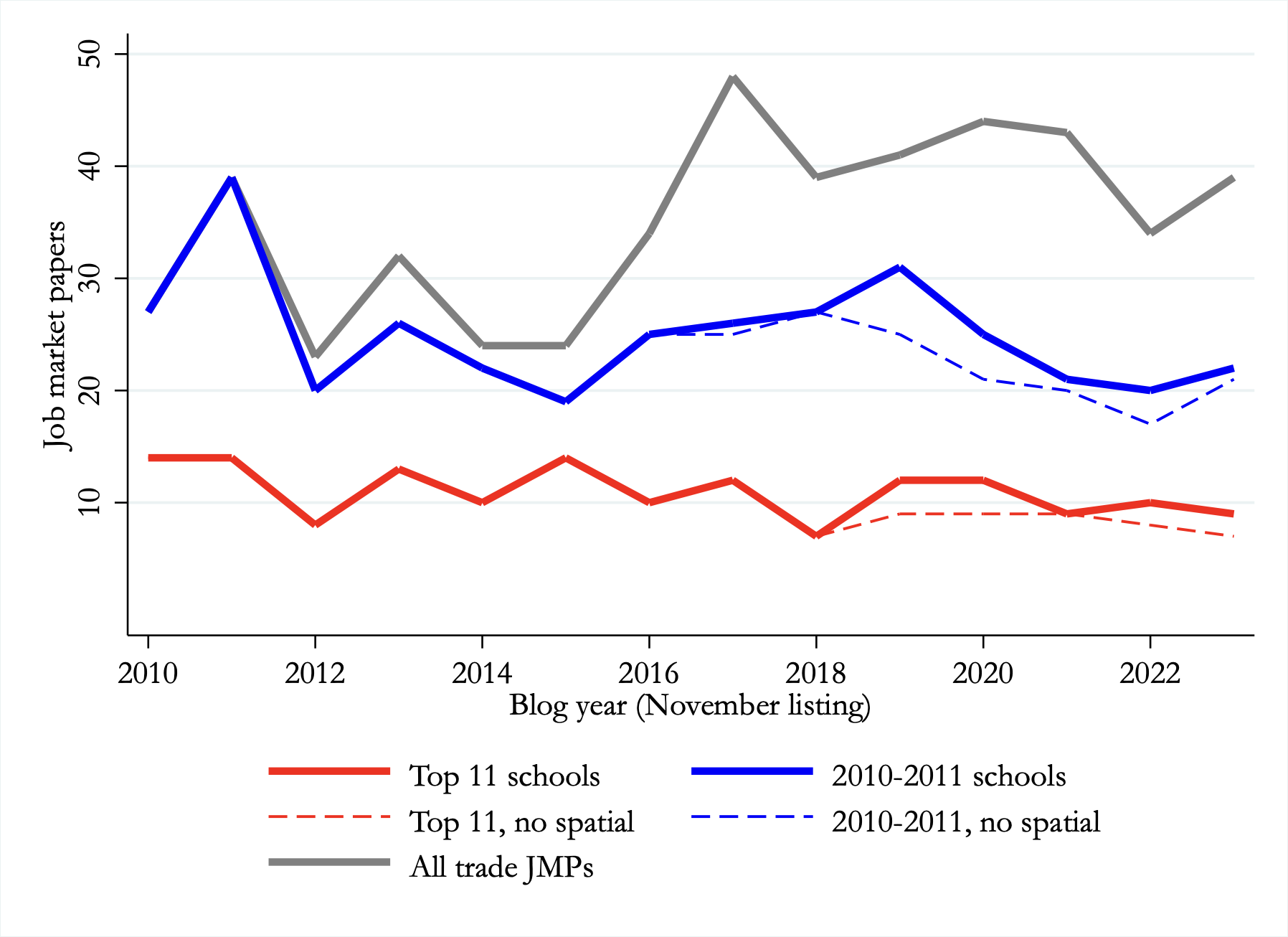
A number of trade economists are worried that PhD students have been losing interest in international trade. One way to measure interest in the field is to tally job-market papers, which I’ve been doing since 2010. The number of JMPs in international trade listed on my blog has grown over time, but the set of schools I cover has been expanding. When looking at the number of trade candidates produced by a fixed set of schools, I expected to find a substantial decline.

I tallied the number of candidates produced by two groups of schools: the schools who had candidates in the first two years of the list (2010-2011) and the top 11 economics departments (US News’ top 10 departments plus LSE). The results surprised me.

tradeJMPs_nospatial

The number of trade JMPs produced by the “original” cohort of schools grew steadily from 2012 through 2019. Only after the onset of the pandemic did the number of trade JMPs decline, and the nadir seen in 2022 was similar to the count of candidates in 2012 and 2015. A very small decline, if any.

The top 11 departments have typically produced about 11 trade JMPs each year over the last 14 years. The average is a little lower after 2017 than before.

I have sometimes included a JMP on both the trade and spatial lists. For example, about one JMP per year from the top-11 schools is cross-listed. If forced to dichotomize, I would have classified some of those JMPs as more spatial than trade. Rather than make such judgments now, the dashed lines present the most conservative approach, which excludes all cross-listed JMPs from the trade tally.

While the number of trade candidates has declined since 2019, this does not necessarily imply a declining market share for international trade. As described in a recent Report of the AEA Committee on the Job Market, the supply of new PhD economists appears to have declined. Both the number of students who applied to at least one job through the JOE and the number who sent a job market signal are down about 10% since 2017. In light of this, the decrease in trade candidates produced by the top 11 departments seems modest.

Cawley_table2

What to make of the surprisingly small decline in trade JMPs? When people complain about the decline of international trade among job-market candidates, do they say “the number of candidates has declined to 2012 levels”? Or are they reflecting on something other than the the raw count of trade JMPs, like placement outcomes or particular styles of research? A counterfactual scenario in which the number of trade JMPs would have been growing if spatial candidates had studied international trade instead?

Trade JMPs (2023-2024)

For the 14th year running, I’ve gathered a list of trade-related job-market papers. If I’ve missed someone, please contribute to the list in the comments.

Here’s a cloud of the words that appear in these papers’ titles:

Agostina Brinatti (Michigan) – Third-Country Effects of U.S. Immigration Policy
Albert Duodu (Lund) – Carbon offshoring and manufacturing cleanup
Alejandra López Espino (Penn State) – Production Networks and Rules of Origin: NAFTA to USMCA
Alejandra Martinez (Warwick) – Trade Relationships During and After a Crisis: Evidence from Road Disruptions in Colombian Flower Exports
Alireza Marahel (Indiana) – Evaluating Alternative Designs for Carbon Border Adjustment Mechanisms
Anaïs Galdin (Princeton) – Resilience of Global Supply Chains and Generic Drug Shortages
Björn Brey (Oxford) – The consequences of a trade collapse: Economics and politics in Weimar Germany
Bumsoo Kim (MIT) – Currency Pegs, Trade Imbalances and Unemployment: A Reevaluation of the China Shock
Carlos Góes (UCSD) – Trade, Growth, and Product Innovation
Carlos Salamanca (Penn State) – Learning to Use Trade Agreements: Rules of Origin
Chang Liu (Rochester) – Foreign Currency Borrowings and Trade Exposure in Emerging Markets
Chengyuan He (Rochester) – Inventories, Production Networks, and International Business Cycles
Dan Zhang (Syracuse) – Export Market Size and Trade Shocks: Evidence for Chinese Firms from U.S. Tariff Changes
Dyanne Vaught (Michigan) – Adjustment Costs and Global Sourcing: An Estimation Using Data on Customs Brokers
Eduardo Fraga (World Bank) – Fertilizer Import Bans, Agricultural Exports, and Welfare: Evidence from Sri Lanka
Elisa Navarra (ECARES-ULB) – The Effects of Subsidies Along Value Chains
Entian Zhang (Minnesota) – Financial Frictions and Sourcing Decisions
Fabrizio Leone (ECARES-ULB) – Global Robots
Jaeeun Seo (MIT) – Sectoral Shocks and Labor Market Dynamics: A Sufficient Statistics Approach
Jin Liu (NYU) – Multinational Production and Innovation in Tandem
Jose Ramon Moran (Michigan) – Rules of Origin and the Use of NAFTA
José Belmar (Brown) – Trade and Structural Change: Evidence from Colombia and The Panama Canal, 1851-1973
Luis Espinoza (Michigan) – Contracting frictions, geography, and multinational firms: evidence from Mexico
Marcos Sora (UChicago) – Labor reallocation during booms: The role of duration uncertainty
Mengqi Wang (Wisconsin) – Spatial implications of trade cost reductions with resource reallocation frictions
Minuk Kim (Minnesota) – The Differential Effect of Tariffs by Quality: Estimates from Scotch
Oriana Montti (Brandeis) – Effects of Trade Barriers on Foreign Direct Investment: Evidence From Chinese Solar Panels
Pedro Degiovanni (Harvard) – Economies of Scale and Scope in Railroading
Philip Economides (Oregon) – Unconventional Protectionism in Containerized Shipping
Sarur Chaudhary (Cambridge) – Globalizing Highways: Domestic Roads and Foreign Inputs
Seungjin Baek (UC Davis) – Transition to a Green Economy: Policy Competition and Cooperation
Sifan Xue (Princeton) – Trade Wars with FDI Diversion
Simeng Zeng (Minnesota) – Misallocation and Technology Upgrading under Trade Liberalization
Sung-Ju Wu (Duke) – Foreign Ownership and Firm Response to Foreign Demand Shocks
Tengyu Zhao (HKUST) – Breaking the Fences: Patent Purchase and Export Performance of Chinese Firms
Tingting Peng (SUNY Albany) – The Impact of Air Connectivity on International Travel: Evidence from Cross-border Card Payments
Toshiaki Komatsu (Chicago) – Job Ladder over Production Networks
Tom Raster (PSE) – Breaking the ice: The persistent effects of pioneers on trade relationships
Veronica Salazar Restrepo (LSE) – Does Conservation Work in General Equilibrium?
Wei Xiang (Yale) – Clean Growth and Environmental Policies in the Global Economy
Zoe Zhang (Warwick) – Breaking Borders: The Impact of Knowledge Diffusion on the Gains from Trade

Spatial economics JMPs (2023-2024)

Here’s a list of job-market candidates whose job-market papers fall within spatial economics, as defined by me quickly skimming webpages. I’m sure I missed folks, so please add them in the comments.

Here’s a cloud of the words that appear in these papers’ titles:

Alaa Abdelfattah (UC Davis) – The Spillover Effect of Large Firms’ Entry on Wage Distribution and Skill Demand
Alba Miñano-Mañero (CEMFI) – When are D-graded neighborhoods not degraded? Greening the legacy of redlining
Alex Hempel (Toronto) – The Impact of Greenbelts on Housing Markets: Evidence from Toronto
Alison Lodermeier (Brown) – Racial Discrimination in Eviction Filing
Amanda Ang (USC) – Paradise Lost: Population Growth and Wildfire Mitigation in the American West
Anaïs Fabre (Toulouse) – The Geography of Higher Education and Spatial Inequalities
Angela Ma (HBS) – Commercial Eviction Moratoria, Liquidity Relief and Business Closure
Anna Ziff (Duke) – Beyond the Local Impacts of Place-Based Policies: Spillovers through Latent Housing Markets
Anthony Tokman (Yale) – Density Restrictions and Housing Inequality
Atsushi Yamagishi (Princeton) – The Economic Dynamics of City Structure: Evidence from Hiroshima’s Recovery
Christian Düben (Hamburg) – The Emperor’s Geography – City Locations, Nature and Institutional Optimisation
Claudio Luccioletti (CEMFI) – Should Governments Subsidize Homeownership? A Quantitative Analysis of Spatial Housing Policies
Cody Cook (Stanford GSB) – Where to Build Affordable Housing? The Effects of Location on Tenant Welfare and Segregation
Daniel Agness (Berkeley ARE) – Housing and Human Capital: Condominiums in Ethiopia
Daniela Arlia (Aix-Marseille) – Labor Market Shocks across Heterogeneous Housing Markets
Derek Wenning (Princeton) – Equal Prices, Unequal Access: The Effects of National Pricing in the US Life Insurance Industry
Evan Soltas (MIT) – Tax Incentives and the Supply of Low-Income Housing
Gabriele Guaitoli (Warwick) – Firm Localness and Labour Misallocation
Gabriele Lucchetti (Nottingham) – Skills, Distortions, and the Labor Market Outcomes of Immigrants across Space
Geetika Nagpal (Brown) – Density, Scale & Affordability: Evidence from a Zoning Deregulation in India
Giorgio Pietrabissa (CEMFI) – School Access and City Structure
Gregory Dobbels (Princeton) – Not in My Back Yard: The Local Political Economy of Land-use Regulations
Guangbin Hong (Toronto) – Two-Sided Sorting of Workers and Firms: Implications for Spatial Inequality and Welfare
Hoyoung Yoo (Wisconsin) – The Welfare Consequences of Incoming Remote Workers on Local Residents
Hugo Lhuillier (Princeton ) – Should I Stay or Should I Grow? How Cities Affect Learning, Inequality and Productivity
Jaeeun Seo (MIT) – Sectoral Shocks and Labor Market Dynamics: A Sufficient Statistics Approach
Jeanna Kenney (Wharton) – Market Concentration, Labor Quality, and Efficiency: Evidence from Barriers in the Real Estate Industry
JoonYup Park (Duke) – Improving Access to Opportunity: Housing Vouchers and Residential Equilibrium
Kulsoom Hisam (Clark) – A Streetcar City: Public transit expansion and neighborhood dynamics in early XXth century Chicago
Laura Weiwu (MIT) – Unequal Access: Racial Segregation and the Distributional Impacts of Interstate Highways in Cities
Lisa Botbol (Toulouse) – Applicant choice in the allocation of social housing: evidence from France
Lorenzo Incoronato (UCL) – Place-Based Industrial Policies and Local Agglomeration in the Long Run
Lukas Mann (Princeton) – Spatial Sorting and the Rise of Geographic Inequality
Maeve Maloney (Syracuse) – Why Are Labor Market Outcomes of Married Women Better in Detroit? The Role of Long and Variable Commutes?
Malabika Koley (Illinois) – Specification Testing under General Nesting Spatial Model
Maria Balgova (IZA) – The death of distance in hiring
Maximilian Guennewig-Moenert (Trinity College Dublin) – Public housing design and racial sorting: Evidence from New York City public housing 1930-2010
Mengqi Wang (Wisconsin) – Spatial implications of trade cost reductions with resource reallocation frictions
Mengwei Lin (Cornell ) – Local Policies and Firm Location: The Role of Leaders’ Promotion Motives in China
Milan Quentel (UPF) – Gone with the Wind: Renewable Energy Infrastructure, Welfare, and Redistribution
Nghiem Huynh (Yale) – Place-based Policy, Migration Barriers, and Spatial Inequality
Nicolás Martínez (Toulouse) – Market coverage and network competition: Evidence from shared electric scooters
Ningyuan Jia (LSE) – Demographic Transition and Structural Transformation in China
Olivia Bordeu (Chicago Booth) – Commuting Infrastructure in Fragmented Cities
Pearl Li (Stanford) – Value Pricing or Lexus Lanes? The Distributional Effects of Dynamic Tolling
Pedro Degiovanni (Harvard) – Economies of Scale and Scope in Railroading
Priyam Verma (Postdoc, AMSE) – Size Distribution of Cities: Evidence from the Lab
Qianyang Zhang (Columbia) – Equilibrium Effects of Building Energy Efficiency Disclosure
Qiyao Zhou (Maryland) – Under Control? Price Ceiling, Queuing, and Misallocation: Evidence from the Housing Market in China
Rebecca Jorgensen (Wharton) – The Consequences of Mergers Between Real Estate Agencies and Mortgage Lenders
Robert French (HKS) – Quantifying the Welfare Impacts of Neighborhood Change on Incumbent Renters
Rowan Isaaks (Vanderbilt) – Revealed Preferences for Residential Traffic Calming: Evidence from Low Traffic Neighborhoods
Ryungha Oh (Yale) – Spatial Sorting of Workers and Firms
Santiago Franco (Chicago) – Output Market Power and Spatial Misallocation
Santiago Hermo (Brown) – Collective Bargaining Networks, Rent-Sharing, and the Propagation of Shocks
Sara Bagagli (Postdoc, Harvard) – The (Express)Way to Segregation: Evidence from Chicago
Seohee Kim (Duke) – Financial Frictions and Geographical Diversification of National Homebuilders
Seungyub Han (UCLA) – Housing Rent, Inelastic Housing Supply and International Business Cycles
Sunham Kim (Purdue) – Human Capital Production in Spatial Economy: A Quantitative Assessment of the Decentralized US Education System
Thiago Patto (Insper) – The Concentration of Economic Activity Within Cities: Evidence from New Commercial Buildings
Tomás Budí-Ors (CEMFI) – Rural-Urban Migration and Structural Change: A Reinterpretation
Yi-Ju Hung (USC) – Immigration and Economic Opportunity
Yige Duan (UBC) – Beyond Lost Earnings: Job Displacement and the Cost of Commuting
Yulu Tang (Harvard) – To Follow the Crowd? Benefits and Costs of Migration Networks

Spatial economics JMPs (2022-2023)

Here’s a list of job-market candidates whose job-market papers fall within spatial economics, as defined by me quickly skimming webpages. I’m sure I missed folks, so please add them in the comments.

Here’s a cloud of the words that appear in these papers’ titles:spatial_words_2022

Brian Cevallos Fujiy (Michigan) – Spatial Knowledge Spillovers in R&D and Aggregate Productivity: Evidence from the Reunification of Germany
Juan Manuel Castro-Vincenzi (Princeton) – Climate Hazards and Resilience in the Global Car Industry
Diana Sverdlin Lisker (MIT) – Fragmented Markets and the Proliferation of Small Firms: Evidence from Mom-and-Pop Shops in Mexico
Howard Zhang (Columbia) – Consumer Cities: The Role of Housing Variety
Kwok-Hao Lee (Princeton) – The dynamic allocation of public housing: Policy and spillovers
Lucas Conwell (Yale) – Are There Too Many Minibuses in Cape Town? Privatized Provision of Public Transit
Michelle Lam (Michigan) – Implications of Zoning on Urban Gentrification in New York City
Mike Mei (Michigan) – House Size and Household Size: The Distributional Effects of the Minimum Lot Size Regulation
Motoaki Takahashi (Penn State) – The Aggregate Effects of the Great Black Migration
Pierre Bodéré (NYU) – Dynamic Spatial Competition in Early Education: an Equilibrium Analysis of the Preschool Market in Pennsylvania
Rajat Kochhar (USC) – Does Market Power in Local Agricultural Markets Hinder Farmer Climate Change Adaptation?
Daniel Ramos-Menchelli (Harvard) – The Spatial Consequences of Financial Frictions: Evidence from Brazil
Shogo Sakabe (Columbia) – Mobile Human Capital and Diffusion of Ideas Across Cities
Shunsuke Tsuda (Brown) – Human and Nature: Economies of Density and Conservation in the Amazon Rainforest
Nishaad Rao (Michigan) – The Intergenerational Wealth Effects of Local Labor Markets
Edward Olivares (Maryland) – Labor Mobility, Nonlocal Outside Options, and Wages
Catherine van der List (UBC) – How do Establishments Choose their Location? Taxes, Monopsony, and Productivity
Elsie Peng (Penn) – The Dynamics of Urban Development: Evidence from New York
Harrison Wheeler (Berkeley) – Locally Optimal Place-Based Policies: Evidence from Opportunity Zones
Lea Bou Sleiman (Ecole Polytechnique) – Displacing Congestion: Evidence from Paris
Lukas Makovsky (London School of Economics) – The Impact of Construction Constraints on Spatial Allocation during Economic Transition
Minseon Park (University of Wisconsin-Madison) – Location Choice, Commuting, and School Choice
Nicole Gorton (UCLA) – Trade Costs, Supply Chains, and the Decline of the Heartland
Pin Sun (Penn State) – Asymmetric Migration Response: An Application to Welfare Analysis in Climate Change
Samuel K Hughes (Wharton) – How Mortgage Financing Costs Affect Rental Housing: Pass-Through & Pricing
Tillmann von Carnap (IIES Stockholm) – Rural marketplaces and local development
Wei Guo (Berkeley ARE) – The Sharing Economy as Disaster Remedy: The Case of Airbnb
Xinle Pang (Penn State) – Moving Into Risky Floodplains: The Spatial Implication of Flood Relief Policies
Yooseon Hwang (Virginia) – The Welfare Effects of Congestion Pricing: Evidence from High-Occupancy Toll Lanes
Tereza Ranošová (Michigan) – Commuting and the value of marriage
Trevor Bakker (Stanford) – The Effects of Foreclosure on Households
Trevor Williams (Yale) – Right Idea, Wrong Place? Knowledge Spillovers and Spatial Misallocation in R&D
Tuuli Vanhapelto (Toulouse) – House Prices and Rents in a Dynamic Spatial Equilibrium
Brian Higgins (Stanford) – Racial Segmentation in the US Housing Market
Anna Vitali (UCL) – Consumer Search and Firm Location: Theory and Evidence from the Garment Sector in Uganda
Augusto Ospital (UCLA) – Urban Policy and Spatial Exposure to Environmental Risk
Benny Kleinman (Princeton) – Wage Inequality and the Spatial Expansion of Firms
Ellen Liaw (UCSD) – The Impact of Place-Based Housing Subsidy on Academic Performance
Erica Moszkowski (Harvard) – Option Value and Storefront Vacancy in New York City
Raoul van Maarseveen (Uppsala University) – The effect of urban migration on educational attainment: evidence from Africa
Garrett Anstreicher (Wisconsin) – Spatial Influences in Upward Mobility
Jiwon Choi (Princeton) – The Effect of Deindustrialization on Local Economies: Evidence from New England Textile Mill Towns
Jungsoo Yoo (University of Pennsylvania) – Local Attachment and Residential Mobility: Evidence from White Flight in Boston
Levi Crews (Chicago) – A Dynamic Spatial Knowledge Economy
Lukas Althoff (Princeton) – The Geography of Black Economic Progress After Slavery
Luke Heath Milsom (Oxford) – Moving Opportunity. Local Connectivity and Spatial Inequality
Martin B. Schmitz (Vanderbilt) – A Penny for your Thoughts
Elio Nimier-David (CREST) – Local Human Capital and Firm Creation: Evidence from the Massification of Higher Education in France
Ninghui Li (UC Davis) – Innovation Clusters and Spatial Inequality with a Local Brain Drain
Rui Yu (Wharton) – Returns to Political Contributions in Local Housing Markets
Samsun Knight (Brown) – Retail Demand Interdependence and Chain Store Closures
Tianfang (Tom) Cui (UPenn Wharton) – The Emergence of Exclusionary Zoning Across American Cities
Vincent Thorne (Trinity College Dublin) – Cycling Toward Cleaner Cities? Evidence from New York City’s Bike Share Program
Zijian He (Yale) – Measuring Welfare Gains from Online Stores: Theory and Evidence from the Supreme Court’s Wayfair Decision

Trade JMPs (2022-2023)

For the 13th year running, I’ve gathered a list of trade-related job-market papers. If I’ve missed someone, please contribute to the list in the comments.

Here’s a cloud of the words that appear in these papers’ titles:

Jay Sayre (Berkeley) – Farm to Firm: Clustering and Returns to Scale in Agricultural Supply Chains
Marina M. Ngoma (Tufts) – Chinese Imports and Industrialization in Africa: Evidence from Ethiopia
Alejandra López Espino (Penn State) – Production Networks and Rules of Origin: moving from NAFTA to USMCA
Antoine L. Noel (Queen’s University) – Production Structures and Preferential Trade Agreements
Eleanor Wiseman (Berkeley ARE) – Border Trade and Information Frictions: Evidence from Informal Traders in Kenya
Benny Kleinman (Princeton) – Wage Inequality and the Spatial Expansion of Firms
Juan Manuel Castro-Vincenzi (Princeton) – Climate Hazards and Resilience in the Global Car Industry
Gizem Kutlu (Virginia) – Gains from Trade with Heterogenous Households
Ji Hye Heo (Vanderbilt) – Product Bundling, Joint Markups and Trade liberalization
Manho Kang (UC Davis) – Export Competition and Innovation
Maria Ptashkina (Universitat Pompeu Fabra) – Revisiting the Effects of Preferential Trade Agreements
Sheng “Charles” Cai (Yale) – Multinational Production, Technology Diffusion, and Economic Growth
Kensuke Suzuki (Penn State) – Gains of Foreign Employment: Regional and Sectoral Implications
Mina Taniguchi (LMU Munich) – What is the impact of EU enlargement? Estimating the wage effect of labor supply shocks with a discrete choice model
Linnea Lorentzen (Norwegian Business School) – Domino Effects: Understanding Sectoral Reallocation and its Wage Implications
Mateo Hoyos (UMass Amherst) – Tariffs and Growth: Heterogeneous Effects by Economic Structure
Nicole Gorton (UCLA) – Trade Costs, Supply Chains, and the Decline of the Heartland
Promise Kamanga (Oregon) – Diplomatic Relations and Trade: The Effect of Switching Ties from Taiwan to China
Takafumi Kawakubo (LSE) – Do Supply Chain Disruptions Harm Firm Performance? Evidence from Japan
Yipei Zhang (Berkeley) – The Anti-Competitive Effect of Input Tariff Liberalization
Joao Monteiro (Kellogg) – The Impact of a Higher Cost of Credit on Exporters: Evidence from a Change in Banking Regulation
Agustin Gutierrez (Chicago) – Labor Market Power and the Pro-competitive Gains from Trade
Jianlin Wang (Berkeley) – Multinationals and Uncertainty: The Role of Internal Capital Markets
Leticia Juarez (Michigan) – Buyer Market Power and Exchange Rate Pass-through
Marco Errico (Boston College) – Decomposing the (In)Sensitivity of CPI to Exchange Rate
Mauricio Stern (Texas) – Windfalls for all? International elasticities and Dutch disease in a commodity exporting economy
Nan Liu (Virginia) – Trade War, Processing Trade, and Global Value Chains
Paul Phillips (Minnesota) – A Tale of Two Recessions: Decomposing Import Patterns After 2020 and 2008
Ruichi Xiong (Toronto) – Interregional Accessibility and Firm Creation in the Fragmented Economy
Sang Min Lee (Minnesota) – Trade Liberalization and Structural Transformation: The Role of Tradable Services
Soo Kyung Woo (Rochester) – Real Exchange Rate and Net Trade Dynamics: Financial and Trade Shocks
Xiaomei Sui (Rochester) – Uneven Firm Growth in a Globalized World
Yukun Ding (USC) – How Does Trade Policy Uncertainty Affect Export: Expectation or Volatility?
Younghun Shim (Chicago) – From Adoption to Innovation: State-Dependent Technology Policy in Developing Countries

Spatial economics JMPs (2021-2022)

Here’s a list of job-market candidates whose job-market papers fall within spatial economics, as defined by me quickly skimming webpages. I’m sure I missed folks, so please add them in the comments.

Here’s a cloud of the words that appear in these papers’ titles:

Zahin Haque (NYU) – The Production Engel
Yuta Suzuki (Penn State) – Local Shocks and Regional Dynamics in an Aging Economy
Yao Wang (Syracuse University) – Linguistic Distance, Internal Migration and Welfare: Evidence from Indonesia
Xian Jiang (Duke) – Information and Communication Technology and Firm Geographic Expansion
Vladimir Avetian (Sciences Po) – Consider the Slavs: Overt Discrimination and Racial Disparities in the Rental Housing
Vinicios Sant’Anna (UIUC) – Send Them Back? The Real Estate Consequences of Repatriations
Vinayak Iyer (Columbia) – What Drives the Efficiency in Ridesharing Markets? Evidence from Austin, Texas
Victor Yifan Ye (BU) – Simulating Endogenous Global Automation
Vasily Rusanov (NYU) – Internal Migration and the Diffusion of Schooling in the US
Valentin Lindlacher (Munich) – Digital Infrastructure and Local Economic Growth: Early Internet in Sub-Saharan Africa
Taylor Mackay (UC Irvine) – Source of Income Discrimination and the Housing Choice Voucher Program
Tanner Regan (LSE) – Ask a local: Improving public pricing in urban Tanzania
Tal Roitberg (USC) – Can’t Wait? Urgency with Strategic Commuters and Tolled Express Lanes
Sung-Yup Jung (BU) – Industrial Parks and Regional Development: Evidence from South Korean Industrial Park Policy
Sarah Schneider-Strawczynski (PSE) – When is Contact Effective? Evidence on Refugee-Hosting and Far-Right Support in France
Rui Yu (Wharton) – Returns to Political Contributions in Local Housing Markets
Rolando Campusano (Toronto Rotman) – Startup Location, Local Spillovers, and Neighborhood Sorting
Philip Mulder (Wharton) – Mismeasuring Risk: The Welfare Effects of Flood Risk Information
Petr Martynov (Berkeley Haas) – Welfare Effects of Zoning: Density Constraints and Heterogeneous Agglomeration
Pawel Janas (Kellogg) – Public goods under financial distress: evidence from cities in the great depression
Paul J. Fisher (Arizona) – The Role of Property Tax in California’s Housing Crisis
Palak Suri (Maryland) – Public Transit Infrastructure and Employment Accessibility: The Benefits of the Mumbai Metro
Nikhil Datta (UCL) – Local Monopsony Power
Motaz Al-Chanati (Columbia) – Residential Segregation and the Demand for Schooling
Mingxi Li (UC Davis) – Firm Foundations: Legal Systems and Economic Performance in Colonial Shanghai, 1903-1934
Michael Pollmann (Stanford) – Causal Inference for Spatial Treatments
Matthew Lilley (HBS) – The Long Run Effects of Right to Work Laws
Mason Reasner (Purdue) – Agglomeration and Congestion Spillovers: Evidence from Base Realignment and Closure
Martin Jégard (PSE) – An Optimal Distribution of Polluting Activities Across Space
Manuela Puente Beccar (Bocconi) – Sorting and health: understanding health inequalities
Luca Perdoni (Yale) – The Effects of Federal “Redlining” Maps: A Novel Estimation Strategy
Kristina Komissarova (NYU) – Location Choices over the Life Cycle: The Role of Relocation for Retirement
Kohei Takeda (LSE) – On the Geography of Structural Transformation: Impact on Inequality and Upward Mobility
Juan Pablo Uribe (Brown) – Subsidies and Market Equilibrium: Evidence from a Notch in the Colombian Housing Market
Josh Morris-Levenson (Chicago) – The Origins of Regional Specialization
Jose Morales-Arilla (HKS) – Autocrats in crisis mode: Strategic favoritism during economic shocks
John Morehouse (Oregon) – Carbon Taxes in Spatial Equilibrium
Jaehee Song (Yale) – The Effects of Residential Zoning in U.S. Housing Markets
Iain Bamford (Columbia) – Monopsony Power, Spatial Equilibrium, and Minimum Wages
Hyun Yeol Kim (Rochester) – Internal U.S. Migration and Consumption Dynamics: A Panel Data Analysis
Georgios Tsiachtsiras (Barcelona) – Transportation Networks and the Rise of the Knowledge Economy in 19th Century France
Filippo Tassinari (Barcelona) – Low emission zones and traffic congestion: evidence from Madrid Central
Fernando Stipanicic (TSE) – The Creation and Diffusion of Knowledge: Evidence from the Jet Age
Fernanda Rojas-Ampuero (UCLA) – Sent Away: The Long-Term Effects of Slum Clearance on Children and Families
Elisa Facchetti (Queen Mary University of London) – Police Infrastructure, Police Performance and Crime: Evidence from Austerity Cuts
Dzhamilya Nigmatulina (LSE) – Misallocation and State Ownership: Evidence from the Russian Sanctions
Dheeraj Chaudhary (Maryland) – Trade, Financial Development, and Inequality: Evidence from US Railroads in the 19th Century
Derek Christopher (UC Irvine) – Homeownership in the Undocumented Population and the Consequences of Credit Constraints
Cory Briar (Oregon) – Rent Control and Gentrification in San Francisco: A Simulation Approach
Cora Wigger (Northwestern) – Decoupling Homes and Schools
Christopher M. Hair (Kellogg) – The Local Effects of Spatially Targeted Public Policies: Evidence from California School Finance Reform
Bunyada (Mos) Laoprapassorn (Michigan) – Entry and Spatial Competition of Intermediaries: Evidence from Thailand’s Rice Market
Benjamin Freyd (UCLA) – Labor Market Polarization and the Growth of Service Employment: Routinization or Consumption Spillovers?
Barthélémy Bonadio (Michigan) – Ports vs. Roads: Infrastructure, Market Access and Regional Outcomes
Arman Khachiyan (UCSD) – The Impacts of Fracking on Microspatial Residential Investment
Antoine Levy (MIT) – Tax Policy and Spatial Investment Behavior
Anomita Ghosh (UIUC) – Developing incentives to move new physicians: Longitudinal evidence from a local supply-side reform
András Jagadits (UPF) – Emigration and Local Structural Change: Evidence from (Austria)-Hungary in the Age of Mass Migration
Abhishek Rai (Penn State) – Temporary Migration in Spatial Economy