Category Archives: Measures, Statistics & Technicalities

Measuring the significance of an FTA partner

Daniel Altman uses a misleading metric to describe the US-Korea trade deal, and I’ve seen this fallacy deployed by a number of others discussing FTAs:

Why is it so important? South Korea ranks just behind the European Union, United States, Japan, China and Hong Kong as an exporter. It shipped $284 billion worth of merchandise in 2005, the last year for which the WTO offers global statistics. That amount, which was three times India’s exports, was also equivalent to the total merchandise shipped by the world’s bottom 118 economies, ranked by the same metric.

All but 30 of those economies are also members of the WTO. So signing a free trade agreement with South Korea could be as economically important as signing agreements with 88 of the group’s 150 members. Given the intense and growing trade relationship between the United States and South Korea, it could be even more important.

Trade agreements are supposed to spur new trade, not entitle partners to claiming the existing volume of trade. (Though the latter might be a rough description of trade diversion.) If the US-Korea FTA doesn’t create any new trade, then it doesn’t matter at all that South Korea is already a massive exporter. Present performance is not a measure of potential gains.

Where are Commerce’s Chinese subsidy calculations?

Dan Drezner is sympathetic to the imposition of countervailing duties on Chinese coated paper exports, since “this policy shift seems to make sense within the context of what those duties are supposed to accomplish.” He links to a NY Times piece describing the Department of Commerce’s previous position on non-market economies: “[I]t is impossible to determine what a subsidy is in a state-controlled economy… Today, that reasoning is regarded as out-of-date as China has moved from a faltering economy two decades ago to an export superpower.”

Is there good reason to believe that the calculation of the countervailing duties has become feasible? The GAO backgrounder I quoted suggested that Commerce’s calculations might rely upon third-country data. The department’s press release (pdf) and fact sheet (pdf) say nothing about how they determined the subsidization rates. (If you know where to find that information, please let me know.)

The specific allegations I’ve seen in the press are low-interest loans, tax breaks, and other subsidies. Given the structure of China’s financial system, I doubt those were easily identified. That means I’m unable to refute Zhou Shijian, a former trade negotiator for China, who says “the U.S. Department of Commerce hasn’t produced substantive evidence.”

Below the fold, I’ve reproduced a few paragraphs from two segments of the USITC’s December determination on coated sheet paper from China, Indonesia, and Korea. (I don’t recommend reading the full 198 pages (pdf).) The first portion is the ruling on the volume of imports. The second is the chairman’s dissent. I think the dissenting opinion, which focuses more greatly on product differentiation, is the preferable interpretation, but the more intriguing aspect is the degree to which the determination depends on the interpretation of a single data point.

Continue reading

Where are Commerce's Chinese subsidy calculations?

Dan Drezner is sympathetic to the imposition of countervailing duties on Chinese coated paper exports, since “this policy shift seems to make sense within the context of what those duties are supposed to accomplish.” He links to a NY Times piece describing the Department of Commerce’s previous position on non-market economies: “[I]t is impossible to determine what a subsidy is in a state-controlled economy… Today, that reasoning is regarded as out-of-date as China has moved from a faltering economy two decades ago to an export superpower.”

Is there good reason to believe that the calculation of the countervailing duties has become feasible? The GAO backgrounder I quoted suggested that Commerce’s calculations might rely upon third-country data. The department’s press release (pdf) and fact sheet (pdf) say nothing about how they determined the subsidization rates. (If you know where to find that information, please let me know.)

The specific allegations I’ve seen in the press are low-interest loans, tax breaks, and other subsidies. Given the structure of China’s financial system, I doubt those were easily identified. That means I’m unable to refute Zhou Shijian, a former trade negotiator for China, who says “the U.S. Department of Commerce hasn’t produced substantive evidence.”

Below the fold, I’ve reproduced a few paragraphs from two segments of the USITC’s December determination on coated sheet paper from China, Indonesia, and Korea. (I don’t recommend reading the full 198 pages (pdf).) The first portion is the ruling on the volume of imports. The second is the chairman’s dissent. I think the dissenting opinion, which focuses more greatly on product differentiation, is the preferable interpretation, but the more intriguing aspect is the degree to which the determination depends on the interpretation of a single data point.

Continue reading

Where are Commerce's Chinese subsidy calculations?

Dan Drezner is sympathetic to the imposition of countervailing duties on Chinese coated paper exports, since “this policy shift seems to make sense within the context of what those duties are supposed to accomplish.” He links to a NY Times piece describing the Department of Commerce’s previous position on non-market economies: “[I]t is impossible to determine what a subsidy is in a state-controlled economy… Today, that reasoning is regarded as out-of-date as China has moved from a faltering economy two decades ago to an export superpower.”

Is there good reason to believe that the calculation of the countervailing duties has become feasible? The GAO backgrounder I quoted suggested that Commerce’s calculations might rely upon third-country data. The department’s press release (pdf) and fact sheet (pdf) say nothing about how they determined the subsidization rates. (If you know where to find that information, please let me know.)

The specific allegations I’ve seen in the press are low-interest loans, tax breaks, and other subsidies. Given the structure of China’s financial system, I doubt those were easily identified. That means I’m unable to refute Zhou Shijian, a former trade negotiator for China, who says “the U.S. Department of Commerce hasn’t produced substantive evidence.”

Below the fold, I’ve reproduced a few paragraphs from two segments of the USITC’s December determination on coated sheet paper from China, Indonesia, and Korea. (I don’t recommend reading the full 198 pages (pdf).) The first portion is the ruling on the volume of imports. The second is the chairman’s dissent. I think the dissenting opinion, which focuses more greatly on product differentiation, is the preferable interpretation, but the more intriguing aspect is the degree to which the determination depends on the interpretation of a single data point.

Continue reading

Bhalla: Raise the Poverty Line

Surjit Bhalla, known for arguing that there are far fewer poor people than conventionally estimated, is putting forth a new bold argument: that more people ought to count as poor. That’s not a reversal of his position; it’s an implication:
Asian and world poverty has declined significantly, and the concept of absolute poverty has receded. Today, absolute poverty in most parts of the developing world is relative; hence the need for a new, and higher, poverty line.

Before arriving at that conclusion, Bhalla challenges numerous other conventional wisdoms. He says that the World Bank overestimates poverty, that world poverty today really means African poverty, and that foreign aid is already adequate in the Jeff Sachs sense — transferred resources are at least equal to the minimum required to eliminate poverty.

I’ve only read the introduction, but I know that this contrarian work is interesting enough to pass it along before having completed it. Bhalla’s paper is “Raising the Standard: The War on Global Poverty” (pdf), part of Joe Stiglitz’s Initiative for Policy Dialogue.

How big is China’s trade surplus?

Brad Setser:

Michael Spence has a Nobel prize in economics, a series of very prestigious academic appointments, friends on the Harvard faculty and access to the opinion page of the Wall Street Journal.

I, obviously, don’t have comparable qualifications — or comparable access to the Wall Street Journal’s oped page.

But I do try to follow the data coming out of China closely. I probably shouldn’t say this, but it sure seemed to me that Dr. Spence got a few key facts wrong in his Wall Street Journal oped…

If you just look at China’s trade surplus (BoP basis), it works out to around 5.5% in 2005 and probably 6.5-7% of China’s GDP in 2006 — numbers comparable to the US trade deficit. Spence’s graph shows China’s trade surplus through 2004. That seems a bit misleading to me: China’s trade surplus ballooned in 2005 and 2006, just when the graph ends. Spence’s argument worked through 2004. It no longer does.

Spence’s side of the debate is behind the WSJ‘s firewall.

Network Topology of International Trade

The Architecture of Globalization: A Network Approach to International Economic Integration” by Javier Reyes and Raja Kali:

We combine data on international trade linkages with network methods to examine the global trading system as an interdependent complex network. We map the topology of the international trade network and suggest new network based measures of international economic integration, at both a global system-wide level and a local country-level. We develop network based measures that incorporate not only the volume of trade but also the influence that a country has on the international trading system. These measures incorporate the structure and function of the network and may provide a more meaningful approach to globalization than current measures based on trade volumes. We find that in terms of participation and influence in the network, global trade is hierarchical with a core-periphery structure at meaningful levels of trade, though integration of smaller countries into the network increased considerably over the 1990’s. The network is strongly “balkanized” according to geography of trading partners but not as strongly by income or legal origin. Using these new measures we find that a country’s position in the network has substantial implications for economic growth and that network position is a substitute for physical capital but a complement to human capital. We therefore suggest that a network approach to international economic integration has potential for useful applications in international business, finance and development.

Last week, I saw Dr. Kali present an application of their measures: “Financial Contagion on the International Trade Network

The data are from the Feenstra et al. NBER set of bilateral trade data by commodity for 1962-2000, which sounds powerful based on Kali’s description.

1.96 is the magic number

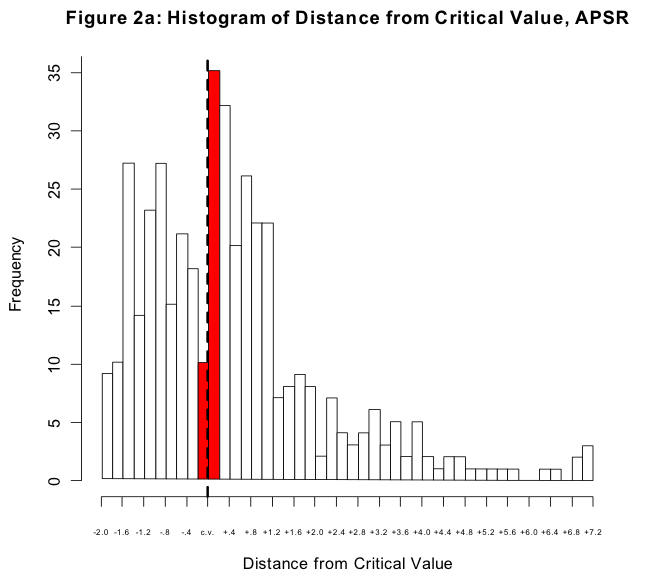
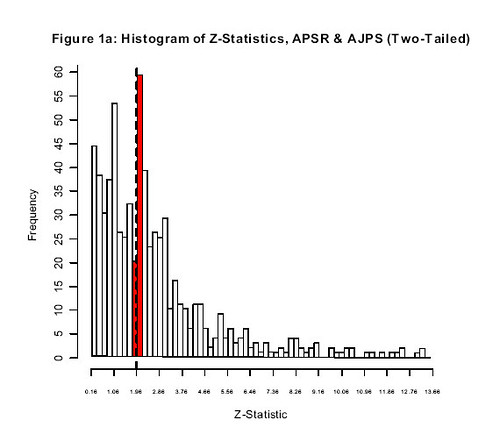
Deirdre McCloskey has long emphasized the warping effects of the “statistical significance” hurdle to publication in economics. Alan Gerber and Neil Malhotra survey the top two journals in political science to produce this finding:

There are plenty of publications with findings that are barely statistically significant and a noticeable absence of papers that fall just short of the goalline. Figure 2a is more damning.

What’s the implication? Andrew Gelman thinks it shows why hypothesis testing is problematic. Kevin Drum says it demonstrates massaging of data. The authors say:

The goal of this paper is to raise awareness of publication bias in political science. We have found that many more results are published just over the p=.05 threshold than below it, implying a certain amount of bias in parameter estimates. Our results suggest that as reviewers, editors, and researchers, political scientists appear to be far too conscious of the .05 significance level, and that this might cause important distortions in how knowledge advances in political science.

Full paper here.