WaPo: “Lower tariff rates reduce tariff revenue!”

Brad DeLong assailed the Washington Post twice today, yet refrained from attacking the front page investigative story centered on this premise:

Each legislative season, corporate executives and lobbyists quietly draft hundreds of bills to suspend tariffs. Over time, the changes cost taxpayers hundreds of millions of dollars in lost revenue, a Washington Post analysis of U.S. trade data found.

No economist is quoted in the story. Apparently the authors didn’t put much effort into finding someone willing to suggest that lower input prices might be good for consumers (a.k.a. taxpayers) and the economy.

Tom Palmer pointed to the story and has more.

[I have some qualms about this form of liberalization, especially its temporary nature, but I don’t buy the WaPo spin.]

William Easterly – The White Man’s Burden

I’m currently reading William Easterly’s The White Man’s Burden, which is pretty well-written and reasonably argued. The most surprising content (for me) was Part III, which is an 80 page case against imperialism and nation building. As an economist, Easterly doesn’t wish to comment on the national security implications of “invading the poor,” but he analyzes the implications for the poor countries themselves.

Easterly opens chapter nine with a mockingly acerbic table. Selected entries:

Intervention Negative consequences Silver lining for United States
Vietnam War, 1961-1975 58,000 American dead; Communists still rule Vietnam; one of poorest countries in world; millions of Vietnamese dead Explosion of Vietnamese restaurants in United States
Cambodia, 1970-73; support of pro-American military ruler; American invading and bombing Khmer Rouge genocide; Vietnamese invasion; today one of poorest, most corrupt, most tyrannized nations Cambodian food is good, too
Backing Haile Selassie in Ethiopia against Soviet-backed Somlia Military overthrows Selassie and aligns itself with Soviets; two decades of civil war; Ethiopia still one of poorest countries in world Live Aid concert to help Ethiopia in 1985 gave valuable experience to Live 8 musicians to help Africa twenty years later
Switching to back Somalia against Soviet-backed Ethiopia Devastation of Ethiopia-Somalia with war-famine; collapse of Somali state and descent into chaos; fiasco of American intervention of 1994 Black Hawk Down was great book and movie
Backing Jonas Savimbi against Soviet-backed Angolan government in 195 and again in 1980s Government wins anyway; civil war continues after Soviet and Cubans leave and American aid ends; Savimbi is power-hungry warlord; land mines outnumber people; spectacular misery today despite great mineral wealth Can’t think of any

1.96 is the magic number

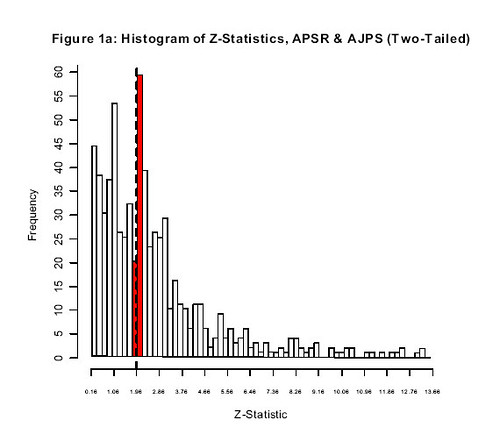
Deirdre McCloskey has long emphasized the warping effects of the “statistical significance” hurdle to publication in economics. Alan Gerber and Neil Malhotra survey the top two journals in political science to produce this finding:

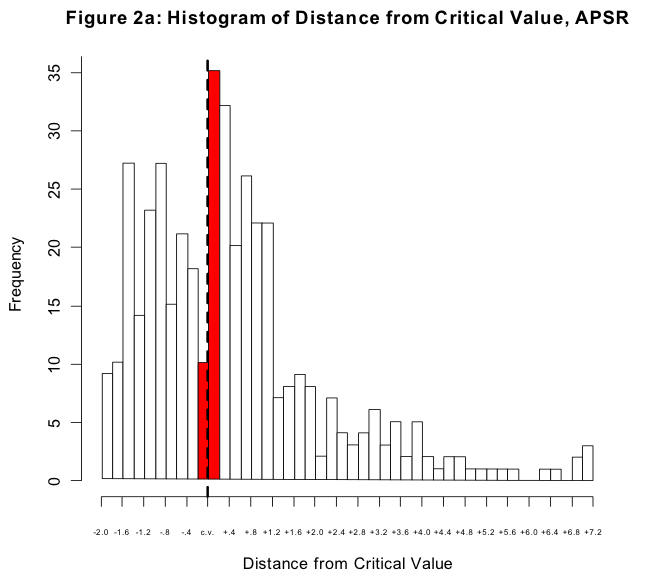
There are plenty of publications with findings that are barely statistically significant and a noticeable absence of papers that fall just short of the goalline. Figure 2a is more damning.

What’s the implication? Andrew Gelman thinks it shows why hypothesis testing is problematic. Kevin Drum says it demonstrates massaging of data. The authors say:

The goal of this paper is to raise awareness of publication bias in political science. We have found that many more results are published just over the p=.05 threshold than below it, implying a certain amount of bias in parameter estimates. Our results suggest that as reviewers, editors, and researchers, political scientists appear to be far too conscious of the .05 significance level, and that this might cause important distortions in how knowledge advances in political science.

Full paper here.

Nobel Prize Predictions

Thomson Scientific suggests a Nobel for international trade theory might be due, shared by Bhagwati, Dixit, and Krugman. That’s one of three possibilities listed at their online poll.

A Tullock-Krueger award for work on rent-seeking wasn’t floated as an option. I’ve seen folks like Bryan Caplan and Barkley Rosser suggest that prize combination, but I don’t know the profession well enough to say if it’s a good prediction.

[HT: Mankiw]

Star-Trib on subsidizing water pollution

Today, in the third installment of “With Water in Mind,” the Star Tribune editorial page begins a five-day series on the way that farmers are polluting the Mississippi River — and the way federal farm policy rewards them for it.

Today’s editorial:

The outrage is that most farmers would readily change their cultivation practices, reducing erosion and nutrient runoff, if they weren’t tied to traditional crops and production patterns by federal farm subsidies. Congress has created several important conservation programs in the last two decades, but the majority of federal farm subsidies still reward farmers for planting the wrong crops in the largest possible quantities.

Protectionist Sentiments

Daniel Drezner trots out some content from his new CFR book in a WaPo column. The most interesting part:

Why has U.S. trade policy ground to a halt? Shifts in domestic attitudes and world politics have combined to create one of the least hospitable environments for trade liberalization in recent memory. The most dramatic shift in opinion came from Americans making more than $100,000 a year. According to the Program on International Policy Attitudes (PIPA), support in that income group for promoting trade dropped to 28 percent in 2004 from 57 percent in 1999. A September 2005 German Marshall Fund (GMFUS) survey revealed that 57 percent believe that freer trade destroys more American jobs than it creates, and 58 percent of Americans would favor raising tariffs for imported goods if it meant protecting jobs — a higher number than in Germany, France, or Great Britain. Healthy majorities believe that trade primarily benefits multinational corporations at the expense of small businesses.

While those surveyed are incorrect about the net impact on jobs, the intuition that trade benefits larger firms and drives out smaller (less productive) firms isn’t far from the logic of the latest trade models. Economists, however, think that effect is good!

[HT: Mankiw]

Congressional stupidity on trade

The worst trade policy suggestion I have heard in a very long time:

Any company that wants to import goods into the United States would have to get a government certificate, under a plan to eliminate the nation’s trade deficit proposed by two Democratic senators Thursday, The New York Times reported Friday.

“We’re choking on trade debt and it is becoming a bigger and bigger danger to our country by the day,” Senator Byron L. Dorgan of North Dakota was quoted as saying. “We need a new strategy, and that is what we are proposing today.”…

Dorgan and Senator Russell D. Feingold of Wisconsin said the bill would create a market-based system to cut the trade deficit to zero within 10 years.

Under the measure, companies that export goods from the United States would be issued a certificate to import goods. The exporter could use the certificate or sell it to another company, the senators said.

The plan would be phased in over five years, with one dollar in exports earning 1.40 dollars in import certificates the first year, 1.30 dollars the second year, 1.20 dollars the third year and so on.

Wow. Wow. That’s all I can say. I’m floored.

[Hat tip to Sallie James.]

Terrorism & Trade: Any Connection?

George A. Pieler and Jens F. Laurson argue that we ought to “defeat terror with trade” in a Forbes commentary piece:

As Robert Klemmensen of the University of South Denmark demonstrated in a study, openness to trade is closely associated with national resistance to being a breeding-ground for, or indeed victim of, terrorism…

America must lead. President George W. Bush’s most controversial post-9/11 policies, especially the prolonged war in Iraq, have cost him much political capital at home and abroad. The Bush administration, short of diplomatic assets to marshal in favor of free trade, can reassume the mantle of economic leadership by pushing unilateral free trade, with its faster economic gains (especially in the developing nations)…

The United States, by challenging its trading partners to action, can burnish its credentials as “exemplar of freedom” in the world by explaining that economic freedom as exemplified by free trade is the first, possibly best “weapon” against terror. Understanding that will enable us truly to transcend the status quo in trade and drive terror back into the dark shadows whence it arose.

Possibly the best weapon against terror? Pieler & Laurson rest their argument on the basis of a single study. Gary Becker, Alberto Abadie, and Alan Krueger & Jitka Maleckova argue that there is little direct connection between poverty, income, and terrorism, once you control for other important variables (namely, political institutions). What does this new study suggest?

Here’s the relevant part pf the abstract of “The political economy of freedom, democracy and terrorism” by Peter Kurrild-Klitgaard, Mogens K. Justesen & Robert Klemmensen:

There seems to be no consistent association of government power with terrorism: economic freedom has little association with terrorism but some with lower levels of political violence, while political freedom associates negatively with political violence but exhibits a non-linear relationship with terrorism. Simultaneously, a number of alternative explanations are disconfirmed: terrorism is unrelated to inequality, economic growth, etc., while a society’s fractionalization has very mixed importance. However, more trade associates with less domestic political violence and occasionally with less probability of terrorism.

Greater freedom to trade (a measure from the Economic Freedom of the World report) is not “closely associated” with reduced terrorism. It is “ocassionally” correlated with a lower probability of terrorism. I spent under ten minutes glancing at the relevant regression results. In table one, the coefficient’s sign is negative in four out of six regressions, and never takes a p-value below 0.10. The case is the same in table two. The second table of regressions also includes trade openness ([M+X]/GDP), which only has the “correct” sign two-thirds of the time. The trade measure is sensitive to the choice of measure of democracy.

I’ve spent a very short time skimming the paper, but given the apparent fragility of the coefficient’s sign (as well as the relatively minor magnitude of the point estimates) and the consensus that growth and poverty have little to do with terrorism, I don’t think that we can “defeat terror with trade.”

[The copy I found online was “a very preliminary draft” presented at GMU in May 2005. Perhaps the published version (Public Choice, July 2006) contains different results. If that’s the case, I’d be curious what revisions were made.]

New Bhagwati book

I am excited to learn that Jagdish Bhagwati is working on a new book:

I am actually halfway through writing a small book titled Termites in the Trading System: How Preferential Trade Agreements are Undermining Multilateral Free Trade. It will advance many other ways in which the proliferation of PTAs is undermining multilateralism in trade.

I hope that he also invests considerable time in suggesting politically feasible solutions to clean up the spaghetti bowl. Regionalism is here to stay, and we need to do more than merely bemoan MFN’s erosion.

[HT: PSD]

Trade Gains & Pains; Concentrated & Diffuse

Brad DeLong:

In the United States, at least, the problem is that most beneficiaries from globalization don’t really know that they are beneficiaries, or how much they benefit.

Brad Setser, via MR:

Walmart’s customers are diffuse and unorganized.  Walmart itself is not.   The customers of US electronics firms that source production in China are diffuse.  But the US firms that make money off the China trade, and benefit from China’s willingness to sell its “assembly services” on the cheap, are a rather concentrated interest. And when it comes to the politics of trade, it seems to me like the customer – represented by the firms that organize global supply chains – usually win, at least on the big issues of real importance to global firms (liberalizing agricultural trade isn’t one of them). 

Richard Baldwin (pdf):

To understand juggernaut liberalisation of intra-industry trade, it is necessary to reach for the very latest trade theories, the so-called new-new trade theory (Melitz 2003, Eaton and Kortum 2002). These models allow for differences in firm size and efficiency and explain why the largest, most efficient firms export while smaller firms sell only domestically. In addition to matching many important aspects of reality, this implies that there is what might be called ‘intra-sectoral special interest politics’. In the new-new trade models, reciprocal trade liberalisation raises the profits of big export firms while lowering the profit of small firms in the same industry that sell only in the local market (Falvey, Greenaway and Yu 2004, Baldwin and Forslid 2004). The intuition is simple. Reciprocal liberalisation harms small firms that sell only locally since it raises the degree of competition they face; they have no exports to benefit from the expanded foreign market access. This leads to a downsizing of such firms with some of them exiting the industry. For the big firms, by contrast, the extra competition at home is offset by better market access abroad. On net they gain since their sales benefit from the downsizing and exit of small firms in both markets. Turning from the economic impact of reciprocal liberalisation to the political economy aspect, the key fact is that there are many more small firms than big firms. Thus, Olsen’s Asymmetry suggests that industries engaged in intra-industry trade will tend to be pro-liberalisation. Notice the juggernaut’s liberalisation-begets-liberalisation features of this mechanism. Big exporting firms drive the liberalisation of sectors marked by intra-industry trade since they are better organised politically than the small firms in the same sector, and the liberalisation itself downsizes the anti-trade small firms while upsizing the pro-trade big firms.

This approach to political economy suggests structural reasons to be optimistic about freer trade, despite the Doha round’s struggles.