Fair Trade Coffee: A Simple Supply and Demand Analysis

I was thinking of writing an op-ed for my school newspaper about Starbucks’ Fairtrade coffee and planned to use an old post by Alex Singleton as one of my reference points. In reviewing the argument that Mexican farmers benefit from Fairtrade at the expense of Ethiopian farmers, however, I found the economic analysis unclear.

Singleton notes that the price of coffee has experienced a downward trend, signally that too much coffee is being produced. He cites mechanization and World Bank loans as decreasing the cost of production. These historical facts mean that the supply curve has previously shifted downward, but they play no role in a partial equilibrium analysis of Fairtrade’s effects today.

As Mr. Singleton describes it, Mexican coffee producers are the marginal producers in the current equilibrium, due to their comparative disadvantage in the production of coffee (higher opportunity costs). A drop in demand would cause these marginal producers to exit.
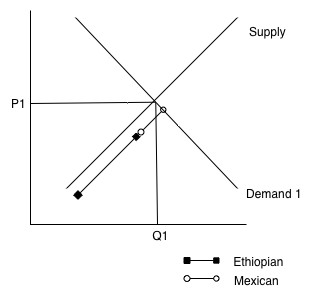
20050820fairtrade1

Singleton argues that Fairtrade induces Mexican producers to stay in the coffee business and that if Mexican farmers switched to growing something other than coffee, Ethiopian farmers growing coffee would benefit. I think that this is incorrect.

Fairtrade is a manipulation of the demand curve, not the supply curve. Singleton agrees by describing participating consumers as willing to “pay a few pence extra for a cup of coffee.” Therefore, the abolition of Fairtrade would cause consumers to offer a lower price at each quantity. This is a downward shift of the demand curve.

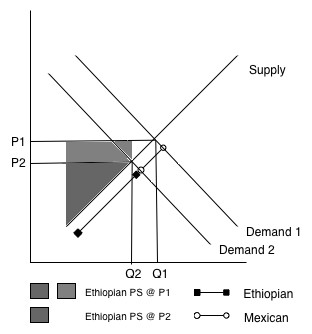
How does a downward shift in demand affect the supply curve? There is a change in quantity supplied, but not a change in the supply curve itself. As such, the marginal producers (Mexican coffee growers) will exit until equilibrium is reestablished. Does this help the Ethiopians?
20050820fairtrade2

Facing fewer competing firms may sound appealing at first, but it’s not beneficial if competitors exited due to insufficient demand. Under Fairtrade, producers that export coffee at a cost below the market equilibrium price earn profits; this is the traditional producer surplus triangle. If it is true that Ethiopians are these lower cost producers, then they will remain in the market when demand falls, but their producer surplus will be reduced. The shaded rectangle is the welfare loss Ethiopians experience due to lower demand. The abolition of Fairtrade and exit of Mexican producers corresponds to lower profits for Ethiopians.

Of course, my analysis up to this point has treated coffee as a unified market. In fact, Fairtrade coffee comprises a small portion of total coffee consumption, so we have to draw separate supply-and-demand graphs for unsubsidized and subsidized coffee, which are substitutes.

Foregoing the actual illustrations, as one can easily imagine them, let’s analyze the effect of increasing Fairtrade participation by consumers. This is an upward shift in the demand curve for Fairtrade coffee. However, as Fairtrade coffee substitutes for unsubsidized coffee, the change in consumer preferences causes a downward shift in the demand curve for unsubsidized coffee.

What are the effects upon producers? Producer surplus will increase in the Fairtrade market and decrease in the unsubsidized market. Thus, the result in ambiguous. Those suppliers that are Fairtrade-certified benefit, whilst non-participants lose profits. If Mexicans are more easily able to form a producer organisation eligible for the Fairtrade label (groups exporting more than 44,000 pounds of coffee per year and able to pay the $2,431 fee) than Ethiopians, then they will benefit at the expense of their African competitors. But if Ethiopians are able to join the Fairtrade program as easily as other coffee producers, then we should not expect Fairtrade’s inflation of the demand curve to have disproportionate negative effects upon them.

The only way for Fairtrade to do no harm to coffee producers would be for all of them to participate. Non-participants do face reduced demand for their product. In its current form, Fairtrade may or may not be net benficial, depending upon the elasticities of the relevant curves and one’s willingness to make interpersonal utility comparisons.

[Comments are open; please post suggestions and corrections.]

Liberalization due to WTO participation in Asia

Two stories on WTO-induced liberalization:

Vietnam: “Accession to the World Trade Organization would throw up jobs in hi-tech fields in Vietnam but also present challenges, a top labor expert said.”

Malaysia: “Come 2008, Malaysia has to bear the full brunt of the liberalisation rules under the World Trade Organisation (WTO) for ‘non agricultural access’ and this covers products like automobiles. Known as the ‘big bang liberalisation’, the picture is rather grim ahead unless Malaysian national car companies become more competitive.”

Will emerging markets produce globallly competitive firms?

Donald Sull of the London Business School has a column in tomorrow’s Financial Express on the viability of firms from developing or newly industrialized countries that pursue international expansion to compete with developed nation companies:

Recent Chinese bids reveal a much broader phenomenon: the rise of fiercely competitive companies from the crucible of emerging markets, including India, Brazil and Mexico as well as China. These emerging market champions pose a much greater threat than most western managers recognise…

The harsh environment overwhelms the majority of emerging market companies. The few that survive the brutal process of Darwinian selection, however, emerge as fierce competitors that excel at efficiency, innovation and risk management. Having conquered local markets, they have strong incentives to expand abroad. Global expansion allows them to tap new markets, spread risk geographically, build economies of scale and compete in many places with multinationals…

The most critical element of these emerging market champions is their diversity. Here the facile analogy with Japan is at its most misleading. Japan’s push towards globalisation was co-ordinated by the government’s trade ministry, targeted at a handful of industries, and pursued by similar companies coming out of the same cosy home market. Emerging market champions, in contrast, vary in headquarter country and industry as well as their strategies to go global…

Executives who lull themselves to sleep with reassuring bedtime stories about Japan may sleep well for now. But they risk waking up to a very unpleasant reality.

Read the full piece for examples of innovative firms and more myth-busting.

WTO & Trade Liberalization: Don’t read blog posts when research papers are available

Posting an answer to a question you posed only four hours earlier is a sure sign of unfamiliarity with the literature in that area. Luckily, Ben Muse has pointed me to Andrew K. Rose’s web page, which contains a plethora of links to his papers and various responses on the topic of the GATT/WTO’s effectiveness in liberalizing trade. I’m going to bury my nose in these papers for a day or two.

Yes, the WTO does liberalize trade

Perhaps I have found an answer to the question posed in my previous post‘s title.

Check out this Economist article for more discussion of the WTO’s effectiveness in liberalizing trade. The paper by Tomz, Goldstein and Rivers that it mentions exhaustively investigates the criterion Rose used to determine GATT participation. By using formal membership as the measure of GATT participation, Rose’s paper neglects the substantial participation by informal member nations:

The solution to this mystery lies in understanding who actually participated in GATT. We show that Rose has overlooked a large proportion of countries to which the agreement applied. By mistakenly classifying many countries as nonparticipants, when in fact they had both rights and obligations under the agreement, he systematically underestimates the effect of GATT on international trade. The purpose of this paper is to identify the full set of GATT participants and, once this institutional detail is understood, to show that GATT did indeed contribute to the substantial growth in postwar trade.

They find that “trade is approximately 72 percent higher when both sides of the dyad participate in GATT and nearly 31 percent higher when only one side participates.”

GATT created rights and obligations not only for contracting parties but also for countries and territories that did not appear on the formal membership roster. By treating colonies, de facto members and provisional members as if they were outside the organization, previous research has understated the institutional research and economic effects of GATT.

Once we account for all participants, our analyses show that participation in GATT— either as a formal member or as a nonmember participant–substantially increased trade. Grouping nonmember participants with nonparticipants causes a substantial downward bias in the estimated effect of GATT membership. When this misclassification is corrected, we find that the agreement proved beneficial for both formal members and nonmember participants, which traded at higher levels than countries outside GATT. These findings withstand a variety of sensitivity tests involving changes in sample definitions and estimation techniques. Overall, GATT exerted a positive effect on trade in nearly all time periods and for most groups of countries.

It would be hasty to dismiss the WTO.

Does the WTO liberalize trade?

In reply to my pessimistic evaluation of trade liberalization’s momentum, Alex Singleton says that I shouldn’t let the best be the enemy of the good, noting that CAFTA, while unpopular, was more politically feasible than unilateral liberalization.

I would normally reply that the realistic alternative to regionalism is multilateralism, not unilateralism, but I just read a paper (PDF) from Andrew K. Rose of Berkeley that argues that the conventional faith in the WTO is misplaced. Using a very traditional gravity model, Rose finds WTO membership to be both economically and statistically insignificant in affecting trade flows, with point estimates occasionally turning out negative. After demonstrating the robustness of this (non-)finding, he ponders:

Of course the most interesting issue that remains is why the GATT/WTO doesn’t seem to have had much of an impact on trade. It is natural to ask whether GATT/WTO members have systematically lower trade barriers. The answer seems to be negative; see Rose (2002). There are at least two possible reasons. The first is that the GATT/WTO has not typically forced most countries to lower trade barriers, especially developing countries that have received “special and differential treatment.” The second reason is that members of the WTO seem to extend most favored nation status unilaterally to countries outside the system, even though they are under no WTO formal obligation to do so. Ongoing research (Rose, 2002) indicates that the negative effect of GATT/WTO membership on trade may appear because membership simply has little effect on trade policy. [Berkeley (PDF)]

In discussing the negative effects of preferential trade agreements, I have sometimes described discriminatory trade policy as damaging the WTO. Dr. Rose’s paper is a good reminder that MFN and low barriers, not membership in the WTO, are the hallmarks of good trade policy. As is often noted, unilateral liberalization, whether spurred by the desire for improved economic performance or forced upon policymakers by a crisis, has occurred frequently during the last half century, but rarely received the attention that is showered upon reciprocal liberalization.

That said, dramatic unilateral liberalization would certainly capture public attention, and Mr. Singleton is likely right that it will not be politically feasible in the near future. As such, free traders ought to devote attention to making the WTO an effective force for liberalization.