Who paid the tariffs imposed by the Trump administration in 2018? Many studies aiming to answer this question have run product-level tariff regressions. These are straightforward to implement and exploit that the administration’s tariffs varied greatly across products, countries, and time.
Overwhelmingly, these regressions show that the pre-tariff price (the price paid to the foreign exporter) did not respond to the Trump tariffs. Rather, the tariff-inclusive price jumped up by about the amount of the tax. Here’s a typical exhibit featuring such a result, from Cavallo, Gopinath, Neiman, Tang (2021):
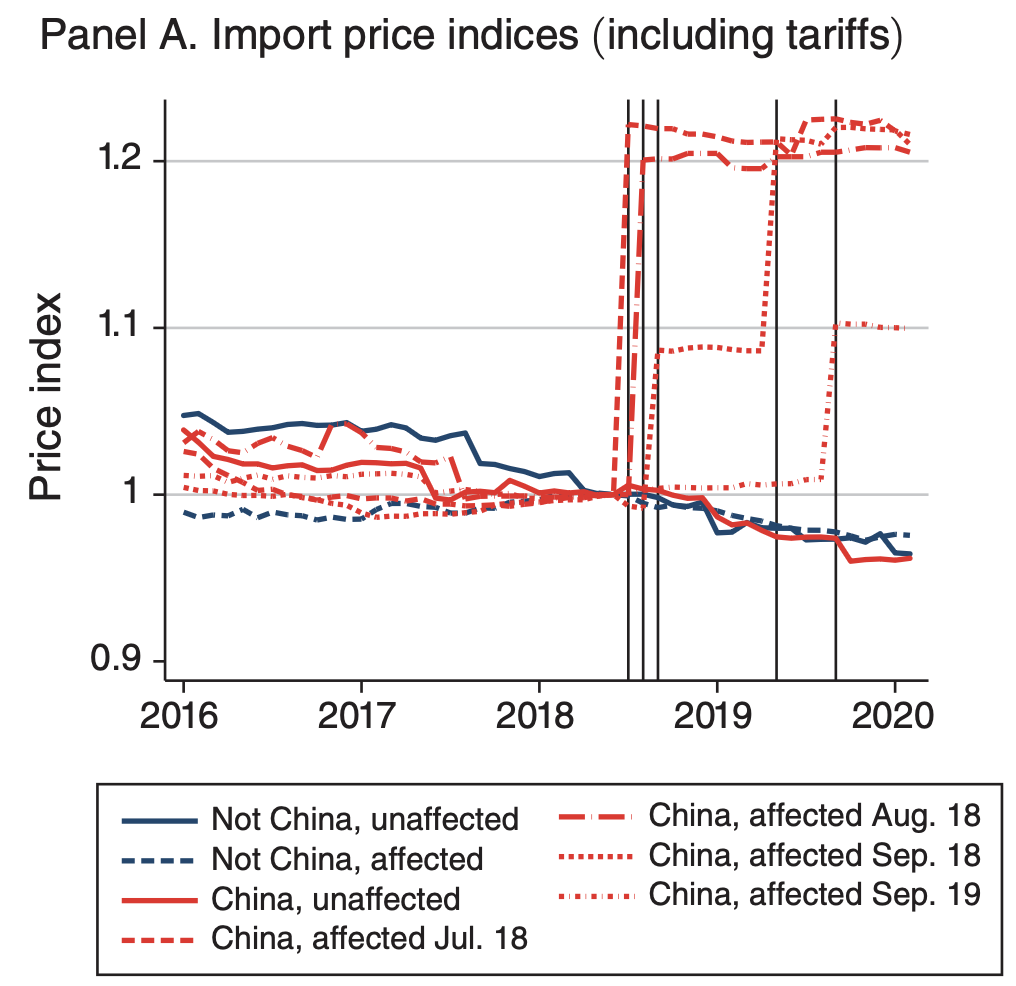
You’ll find similar exhibits in Amiti, Redding, Weinstein (2019) and Fajgelbaum, Goldberg, Kennedy, Khandelwal (2020).
Do these patterns mean that the US is a small open economy and that its trade policy has no effect on prices paid to foreign exporters? We need a bit of theory to connect product-level tariff regression results to changes in the US terms of trade.
Let’s work this out in the Ricardian trade model of Dornbusch, Fischer, and Samuelson (1977), my favorite model for thinking through most trade questions. Recall that DFS77 features two countries, a continuum of goods, and the (double-factoral) terms of trade are just relative wages. All else equal, Home is better off when is higher. (Set as the numeraire for convenience.)
What does a product-level tariff do in DFS77? Foreign’s export supply curve for good is perfectly elastic at price . When Home applies a tariff, either Foreign still exports it at the same producer price with the Home consumers bearing the full incidence of the tax, or Home becomes the least-cost supplier of good and it ceases to be traded. For the “continuing” set of imported products, there is complete pass-through of import tariffs to tariff-inclusive import prices.
Because product is measure zero, doesn’t move in response to the tariff on . But suppose exogenous supply shocks might move or , such that we want to compare product to a control product that experiences similar shifts in input prices or input requirements. We would then estimate a product-level tariff regression with time fixed effects and product fixed effects in order to see how the price of the tariffed good responds relative to other goods. This difference-in-differences regression would show complete product-level pass-through.
Is Home powerless to manipulate its terms of trade in DFS77? Far from it. Suppose that Home applies a uniform tariff to all goods. Equations (23) and (26) in DFS77 tell us that “an increase in the tariff improves the imposing country’s relative wage and terms of trade”. In this model, to change the terms of trade, one must use tariffs to move relative wages. Tariffs on a non-zero measure of products do move the foreign wage , but that input price shifts the product-level export supply curves of both tariffed and non-tariffed products. The difference-in-differences regression aims to difference out shifts in .
The advantage of working through an explicit model of international trade is that it clarifies the meaning of the estimand. A product-level tariff regression need not answer the question “did the Trump tariffs improve the US terms of trade?”.
This is why Fajgelbaum, Goldberg, Kennedy, Khandelwal (2020) report both “prices of imports targeted by tariffs did not fall, implying complete pass-through of tariffs to duty-inclusive prices” and “the results do not imply that the United States is a small open economy unable to affect world prices, as terms-of-trade effects could have occurred through wage adjustments at the country-sector level.” In their quantitative model of the US supply side, they get “a model-implied 0.7% increase in the export price… Because import prices essentially do not change, these export price changes mean terms-of-trade improvements at the country level.”
At this summer’s NBER ITI meeting, Adao, Beirne, Costinot, Donaldson made this point in a paper in which they attempt to estimate both the product-level response and the aggregate response to tariffs. A “micro” regression comparing tariffed products to otherwise similar products shows very little change in the exporter’s price, whereas a “macro” regression shows that a country’s average export price does respond to its overall exposure to tariffs. Such a contrast is consistent with the DFS77 distinction: full pass-through at the product level, but, absent retaliation, tariffs do improve the imposing country’s terms of trade.
 Trade Diversion