Visa Restrictions

The global liberalization of factor movements is a messy, selective and uneven process. Capital might be flowing more freely than persons:

A study of global visa regimes has signalled that governments will have to reconcile their push for democracy, free trade and open-market globalisation with the increasingly restrictive and inequitable visa curbs on free movement of people. The study says that visa restrictions have created a system that ”is one of highly unequal access to foreign spaces, reinforcing existing inequalities”.

When it comes to enjoying visa-free travel to foreign countries, passport holders from rich nations form an exclusive club of 25 countries facing the fewest restrictions for going abroad, according to the research conducted by Dr Eric Neumayer, a geographer from the London School of Economics. [Bangkok Post]

New Sachs Article

Jeff Sachs has an article titled “Can Extreme Poverty Be Eliminated?” in the latest issue of Scientific American. Much of its content will be familiar to those who have followed Sachs’ work over the last year or so. This is the paragraph that I found most intriguing:

A new kind of development economics needs to emerge, one that is better grounded in science–a “clinical economics” akin to modern medicine. Today’s medical professionals understand that disease results from a vast array of interacting factors and conditions: pathogens, nutrition, environment, aging, individual and population genetics, lifestyle. They also know that one key to proper treatment is the ability to make an individualized diagnosis of the source of illness. Likewise, development economists need better diagnostic skills to recognize that economic pathologies have a wide variety of causes, including many outside the traditional ken of economic practice.

Rules of origin as a constraint upon development

Paul Brenton and Takako Ikezuki note ways in which rules of origin can hamper economic development in a working paper from April 2004:

Strict rules of origin are viewed by some as a mechanism for encouraging the development of integrated production structures within developing countries to maximize the impact on employment and to ensure that it is not just low value-added activities that are undertaken in the developing countries. However, there is no evidence that strict rules of origin over the past 30 years have done anything to stimulate the development of integrated production structures in developing countries. In fact such arguments have become redundant in the light of technological changes and global trade liberalization that have led to the fragmentation of production processes and the development of global networks of sourcing.

Strict rules of origin act to constrain the ability of firms to integrate into these global and regional production networks and in effect act to dampen the location of any value-added activities. In the modern world economy, flexibility in the sourcing of inputs is a key element in international competitiveness. In the clothing industry, for example, modern analyses show that the key to moving up the value chain is to shift from simple assembly toward design and ultimately production of own label products. Limitations on the sourcing of materials will be a constraint rather than a stimulus to higher value-added activities.

Thus, it is more than likely that the imposition of restrictive rules of origin rather than stimulating economic development raises costs of production by constraining access to cheap inputs and undermines the ability of firms to compete in overseas markets. It is also no coincidence that restrictive rules of origin act to protect U.S. clothing producers and stimulate demand for U.S. made fabrics. It is perhaps ironic that whilst technical assistance and advice to many of the countries in the region is stressing the importance of access to low cost imported inputs and the need to remove logistical and bureaucratic barriers for competitiveness and growth of exports, the rules of origin that will be imposed under AGOA on clothing products in 2004 will act in exactly the opposite way. They will constrain access to low-cost imported inputs and will raise bureaucratic barriers to exports.

Trade’s future: Marinara, Alfredo, or Szechuan?

The spaghetti bowl is getting quite thick. The follow partners are moving towards preferential trade agreements: Australia-Malaysia, Jordan-Russia, Chile-China, India-GCC, Thailand-Japan, Egypt-USA.

But while regionalism seems to be driving multilateralism into obsolescence, unilateral trade liberalization by China might overtake them both, argues Razeen Sally.

“The image I’d ask you to bear in mind is of China assuming the role that Britain had in the second half of the 19th century — in other words, China as the unilateral engine of freer trade that sets up competitive and emulative effects not least in the neighbourhood of South and Southeast Asia,” Sally told a conference organised by Beijing University and the LSE.

Excellent news, if it comes true. I’ve long preferred Chinese food to Italian.

Markets on the retreat in Asia

India: “Calling himself a liberal in social philosophy, the Prime Minister, Dr Manmohan Singh, today said Marxism captures two very important aspects for the progress of a nation… These insights of Marxism must guide any development policy design, the Prime Minister said.”

Vietnam: “Pham Chi Lan, senior advisor to the Research Commission, a socio-economic think-tank advising the Prime Minister, was objecting to some analysts’ suggestion that the government would soon let world prices determine domestic fuel prices… ‘I think we cannot do that as fuel is a very sensitive product, with a great bearing on the economy,” she said. “It needs government supervision.’”

Fair Trade Coffee: A Simple Supply and Demand Analysis

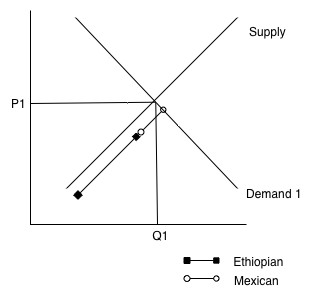
I was thinking of writing an op-ed for my school newspaper about Starbucks’ Fairtrade coffee and planned to use an old post by Alex Singleton as one of my reference points. In reviewing the argument that Mexican farmers benefit from Fairtrade at the expense of Ethiopian farmers, however, I found the economic analysis unclear.

Singleton notes that the price of coffee has experienced a downward trend, signally that too much coffee is being produced. He cites mechanization and World Bank loans as decreasing the cost of production. These historical facts mean that the supply curve has previously shifted downward, but they play no role in a partial equilibrium analysis of Fairtrade’s effects today.

As Mr. Singleton describes it, Mexican coffee producers are the marginal producers in the current equilibrium, due to their comparative disadvantage in the production of coffee (higher opportunity costs). A drop in demand would cause these marginal producers to exit.

20050820fairtrade1

Singleton argues that Fairtrade induces Mexican producers to stay in the coffee business and that if Mexican farmers switched to growing something other than coffee, Ethiopian farmers growing coffee would benefit. I think that this is incorrect.

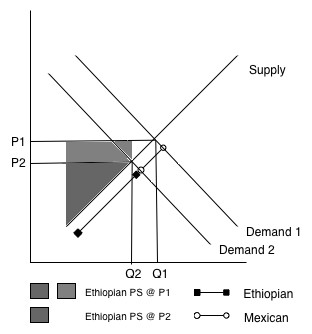
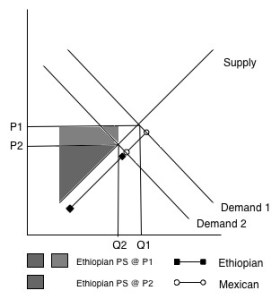
Fairtrade is a manipulation of the demand curve, not the supply curve. Singleton agrees by describing participating consumers as willing to “pay a few pence extra for a cup of coffee.” Therefore, the abolition of Fairtrade would cause consumers to offer a lower price at each quantity. This is a downward shift of the demand curve.

How does a downward shift in demand affect the supply curve? There is a change in quantity supplied, but not a change in the supply curve itself. As such, the marginal producers (Mexican coffee growers) will exit until equilibrium is reestablished. Does this help the Ethiopians?
20050820fairtrade2

Facing fewer competing firms may sound appealing at first, but it’s not beneficial if competitors exited due to insufficient demand. Under Fairtrade, producers that export coffee at a cost below the market equilibrium price earn profits; this is the traditional producer surplus triangle. If it is true that Ethiopians are these lower cost producers, then they will remain in the market when demand falls, but their producer surplus will be reduced. The shaded rectangle is the welfare loss Ethiopians experience due to lower demand. The abolition of Fairtrade and exit of Mexican producers corresponds to lower profits for Ethiopians.

Of course, my analysis up to this point has treated coffee as a unified market. In fact, Fairtrade coffee comprises a small portion of total coffee consumption, so we have to draw separate supply-and-demand graphs for unsubsidized and subsidized coffee, which are substitutes.

Foregoing the actual illustrations, as one can easily imagine them, let’s analyze the effect of increasing Fairtrade participation by consumers. This is an upward shift in the demand curve for Fairtrade coffee. However, as Fairtrade coffee substitutes for unsubsidized coffee, the change in consumer preferences causes a downward shift in the demand curve for unsubsidized coffee.

What are the effects upon producers? Producer surplus will increase in the Fairtrade market and decrease in the unsubsidized market. Thus, the result in ambiguous. Those suppliers that are Fairtrade-certified benefit, whilst non-participants lose profits. If Mexicans are more easily able to form a producer organisation eligible for the Fairtrade label (groups exporting more than 44,000 pounds of coffee per year and able to pay the $2,431 fee) than Ethiopians, then they will benefit at the expense of their African competitors. But if Ethiopians are able to join the Fairtrade program as easily as other coffee producers, then we should not expect Fairtrade’s inflation of the demand curve to have disproportionate negative effects upon them.

The only way for Fairtrade to do no harm to coffee producers would be for all of them to participate. Non-participants do face reduced demand for their product. In its current form, Fairtrade may or may not be net benficial, depending upon the elasticities of the relevant curves and one’s willingness to make interpersonal utility comparisons.

[Comments are open; please post suggestions and corrections.]