I haven’t seen the inside of John McLaren’s new international trade textbook

I haven’t seen the inside of John McLaren’s new international trade textbook
Some recent VoxEU columns:
Who’s on the job market this year with a paper on international trade? As usual, I focus on trade papers, thereby neglecting international finance and open-economy macro papers and trade economists working in other fields. I’m a bit late this year, so please help me by identifying more candidates in the comments section. [Update: Thanks to Rm and Bernardo for their comments.]
Here’s an analytic framework that’s almost surely wrong:
What do market economies have to do with cities?
Well, obviously cities are economic entities. To survive, a city or a region has to make money; it has to export more than it imports, in dollar terms. Cities that decline are on the losing side of this equation. So if you care about cities, which I do, it leads you to think about how they function as economic entities.
Alex Marshall’s new book doesn’t mention exports in the context of cities, so I don’t have a way to follow up on the logic underlying this claim. But trade surpluses are not at the heart of urban growth in any urban economics literature I’ve read.
[HT: Aaron Brown]
This blog has a long history of covering preferential trade, as the title suggests. But I don’t follow proposed trade deals very much these days, largely because serious trade proposals haven’t been forthcoming in recent years.
If I had been paying attention, I would have noticed “a slow and steady effort to generate support for a U.S.-EU free trade agreement” “over the past year or so”, as noted by Simon Lester. At the WaPo, David Ignatius reports/opines:
But a big idea is taking shape that could revitalize the U.S.-European partnership for the 21st century. It was the talk of Berlin and Hamburg when I was there a week ago, and there’s a similar buzz in Washington. The idea is free trade — specifically, a trans-Atlantic free-trade agreement — which I’ll optimistically call “TAFTA.”
Secretary of State Hillary Clinton tipped the U.S. hand on Nov. 29 when she said at the Brookings Institution, “We are discussing possible negotiations with the European Union for a comprehensive agreement that would increase trade and spur growth on both sides of the Atlantic.”…
Curious as to whether Clinton’s speech was just window dressing from a departing secretary, I asked the White House this week whether the TAFTA talk is real. The answer was yes: Obama is considering making a trans-Atlantic trade initiative an important part of his second-term agenda. Combined with the North American Free Trade Agreement in Latin America and the Trans-Pacific Partnership in Asia, this could create a global trading system that might be an enduring part of Obama’s legacy.
See Simon Lester for one set of reasons to be skeptical.
Given (my uninformed impression of) current trade politics in the US, I see little reason to take TAFTA seriously at this stage. The Trans-Pacific Partnership negotiations have been going for about five years (with 15 rounds of formal negotiations over the last three years), so I’d be shocked if there were any accelerated action on the TAFTA front.
The Economist is six months late to the party, but the latest print edition has a piece on that McKinsey comparison of American and Europe cities. I have some quibbles, again.
I don’t understand the piece’s opening, though it has little to do with what follows. It begins:
AMERICA is full of vast, empty spaces. Europe, by contrast, seems chock-a-block with humanity, its history shaped by a lack of continental elbowroom. Ironically, Europe’s congestion partly reflects the fact that its large cities suck up relatively few people.
Moving people across cities wouldn’t change the (unweighted) average population density of the US or EU, so what does this comparison mean? Europe is going to be full of humanity because the land area of the EU is roughly half that of the continguous US (1.7m vs 3.1m square miles). Since larger cities are generally denser, the population-weighted density of Europe would rise if its large cities had higher population shares.
Never mind the elbowroom. The Economist continues:
Although America and the euro zone have similar total populations, America’s 50 largest metropolitan areas are home to 164m people, compared with just 102m in the euro area. This striking disparity has big consequences.
Differences in metropolitan populations may help explain gaps in productivity and incomes. Western Europe’s per-person GDP is 72% of America’s, on a purchasing-power-parity basis. A recent study by the McKinsey Global Institute, the consultancy’s research arm, reckons that some three-quarters of this gap can be chalked up to Europe’s relatively diminutive cities. More Americans than Europeans live in big cities: there is a particular divergence in the size of each region’s “middleweight” cities, those that teem just a little less than the likes of New York and Paris (see chart). And the premium earned by Americans in large cities relative to those in the countryside is larger than that earned by urban Europeans.
As I explained back in April, the MGI report does not say Europeans would reach American prosperity levels if the population shares of their large cities reached American levels:
The gap in per capita GDP between the US and Europe is about 35%, according to the MGI figures in Exhibit 2. The “large city” premia in the United States and Europe of 34% and 30% are virtually the same. That means that the difference in per capita income attributable to the difference in “large city” population shares is the large city premium (~30pp) times the difference in large city population shares (22pp). The six to seven percentage points explained by this difference in population shares is at best one-fifth of the 35% gap between US and EU incomes. You can confirm this quick calculation by studying the decomposition in MGI’s Exhibit 2. Moving more people into large cities wouldn’t meaningfully reduce the US-EU per capita income gap.
Look at Exhibit 2 for yourself:
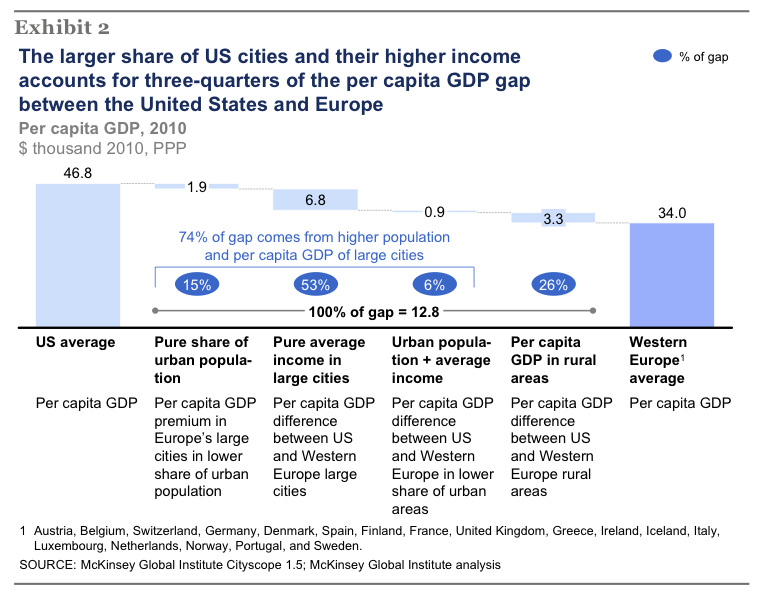
The Economist mentions the big-city population share and big-city premium components. They neglect that 53 of those 74 percentage points are strictly attributable to the difference in average income. Differences in metropolitan populations are not at the heart of the story.
After citing all the advantages of cities, the Economist considers two reasons why European cities aren’t as large as US cities: regulatory barriers and incomplete integration. While the former might matter, I put a lot of stock in the latter. As I explained in my prior post, Zipf’s law holds at the country level. Since no European state has a population close to 300 million, we should not expect any European city to approach the size of NYC or LA. Until intra-European mobility looks anything like intra-US mobility, I think we should expect Zipf’s law to hold at the country level. And since MGI used a common cutoff of population > 150,000 for defining a “large city”, it’s not at all surprising that a larger share of the US population lives in its large cities. I wrote before:
Given the UK population, increasing the fraction of UK residents who live in “large cities” with populations greater than 150,000 would require the emptying out of smaller metropolitan areas. While such migration is entirely possible, it would violate the expected city size distribution… If you know the populations of New York and London and are familiar with Zipf’s law, then it’s not at all surprising that a greater fraction of the US population is found in metropolitan areas above some common population threshold. I don’t think that tells us much about the economic mechanisms determining the role of US cities in the global economy.
Update: Related to my comparison of US and UK city-size distributions, see Henry Overman on the details of Zipf’s law for UK cities.
from the Economist:

I’ve followed the African Growth and Opportunity Act for a long time. This piece of US legislation gave preferential market access to exports from designated African countries, particularly in textiles and apparel. African economies experienced significant export growth in the early 2000s; the question was whether that growth should be attributed to AGOA and the EU’s Everything But Arms initative. The policy debate has been interesting in various ways: AGOA came under fire from both libertarians and Joe Stiglitz while finding favor with those in between.
The most favorable interpretation of the policy was that its temporary advantage would launch manufacturing clusters in Africa. And when researchers found that AGOA had a strong positive impact on African exports, it looked like the policy was spurring industrial growth.
That makes new research (pdf) from friend-of-the-blog Pierre-Louis Vezina (co-authored with Lorenzo Rotunno and Zheng Wang) very intriguing:
During the final years of the Multifiber Agreement the US imposed strict import quotas on Chinese apparel while it gave African apparel duty- and quota-free access. The combination of these policies led to a rapid but ephemeral rise of African exports. In this paper we argue that the African success can be explained by a temporary transhipment of Chinese apparel driven by quota-hopping Chinese assembly firms. We first provide a large body of anecdotal evidence on the Chinese apparel wave in African countries. Second, we show that Chinese apparel exports to African countries predict US imports from the same countries and in the same apparel categories but only where transhipment incentives are present, i.e. for products with binding quotas in the US and for countries with preferential access to the US unconstrained by rules of origin. Using input-output linkages, we then show that African countries imported quasi-finished products with little assembly work left to do, rather than primary textile inputs. We estimate that direct transhipment may account for around half of AGOA countries apparel exports.
The abstract certainly caught my attention; I look forward to reading this paper.
iPhones are a hot example of vertical specialization in the world economy. Scott Lincicome passes along a graphic that describes just how many different economies are involved in producing a single piece of textile clothing.

If you aren’t following Trade Diversion on Twitter, here’s what you missed recently:


